


This page contains Amazon affiliate links. As an Amazon Associate we may be paid a commission if you buy something through them, which costs you nothing.
Choosing a metallic epoxy pigment comes down to one moment: the pour. These picks differ on three things: what the pigment is made from, how much control you get over opacity, and whether it’s built for a small craft project or a full floor. Some are mica, some are true metal, and one is sized for gallons of epoxy.
1. Rolio Premium Mica Powder Pearlescent Set -10g

Best for: Crafters who want a wide range of colors in small jars
Rolio’s set is 24 resealable jars of mica powder, roughly 10 grams each. The listing stakes its case on professional-grade pigment that goes far, so you don’t need much powder to get the color you want. The range of colors is the point here — you’re buying variety, not one signature tone.
Strengths:
- 24 jars in one set, each resealable
- Cosmetic-grade pigment for soap and makeup use
- Fine powder formulated for easy mixing
- Strong pigment, so a little goes a long way
- Works across resin, candles, slime and nail polish
Trade-offs:
- Listing notes loose powder may sit on jar exteriors
- Small jars suit craft projects, not large pours
Living with this set means keeping 24 small jars organized and labeled so you aren’t hunting for a color mid-project. You’d get used to scooping a little at a time, since the pigment is concentrated and the listing says a small amount does the job. The cosmetic-grade claim is what makes it flexible — the same jar can go into a soap batch or a resin coaster. What you’d stop worrying about is running out of a color, because the set covers so many.
| Best for | Why |
|---|---|
| Soap and candle makers | Cosmetic-grade pigment suits these crafts |
| Resin jewelry crafters | Small jars match small pours |
| Beginners building a palette | 24 colors in one set |
2. CHANGTIKEJI Mica Powder 48

Best for: Buyers who want the widest color range in one box
This set brings 48 colors, each bottle 10 grams, made from processed natural mica minerals. The listing leans on the color combination as the surprise — a full spectrum in a single purchase. It also ships with two spoons, a brush and a bottle opener, which tells you the seller expects you to be scooping and applying powder by hand. The listing is upfront that different colors have different densities, so jars won’t all look equally full even though each weighs 10 grams.
Strengths:
- 48 colors
- Natural mica mineral base, listed as non-toxic
- Includes two spoons, a brush and a bottle opener
- High-density pigment, so a little goes a long way
- Listed as easy to mix and dissolve in resin
Trade-offs:
- Color density varies, so jars look unevenly filled
- Listing advises adding pigment a little at a time
With 48 bottles, storage and labeling become a real routine — you’d want a rack or a labeled drawer to keep colors findable. The included tools mean you can start the day it arrives without buying anything else. Because the listing warns that some jars look fuller than others, you’d learn to judge by weight and result rather than by eye. That’s the honest trade of buying a large natural-mica set.
| Best for | Why |
|---|---|
| Hobbyists who want every color | 48 shades cover the spectrum |
| Resin artists on varied projects | Wide range suits changing palettes |
| Gift buyers | Large set with tools included |
3. Metallic Pigment Powder 5-Color
Best for: Beginners who want the classic metallic tones only
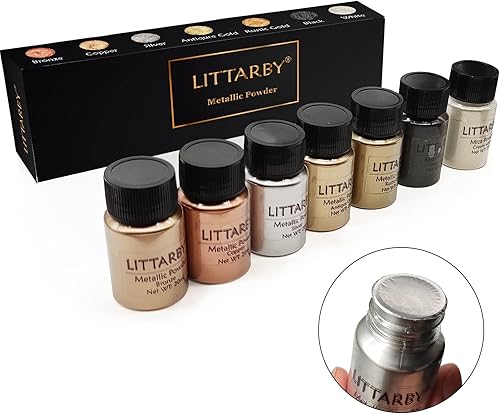
This LITTARBY set is five jars of fine mica pigment in the tones most people reach for first: rose gold, antique gold, rustic gold, copper and silver. The listing also names black and cream white as basic colorants for resin and soap. Each jar holds 20ml, labeled with the color name so you can grab the right one without opening it. The seller’s case rests on covering power — the powder is described as silky, strongly pigmented and giving a real metal look.
Strengths:
- Five core metallic tones in labeled 20ml jars
- Listed as strong covering power and silky texture
- Mixes into resin, water, paint, varnish and glue
- Color names printed on jars for quick ID
- Suits kintsugi, polymer clay and tray projects
Trade-offs:
- Only five colors, so no broad palette here
Five jars means less deciding and less back-and-forth — you grab gold, pour, and move on. The labeled lids matter more than they sound, because metallic powders look similar in the jar and you’d otherwise open three before finding copper. The listing says a bit is enough to make color pop, so you’d be working in small scoops rather than pouring freely. What you give up is range: this is the set for someone who knows they want gold and silver, not someone exploring 40 shades.
| Best for | Why |
|---|---|
| First-time resin crafters | Five familiar tones, low decision load |
| Kintsugi and clay artists | Metallic finish suits repair and sculpting |
| Makers who mix into paint | Blends with water, varnish and glue |
4. MEYSPRING Sterling Lining True Metallic Silver Pigment

Best for: Resin artists who need a true silver metal finish
This is 100% aluminum pigment powder, 50 grams, and the listing is direct that it’s true metallic rather than mica. That distinction is the whole case: the listing describes aluminum particles as giving an opaque, authentic metal look. The seller describes extra-fine particles and high concentration, so a small amount produces fully opaque results. It’s aimed at deep pours, geodes, castings and inlays where you want silver to read as metal, not shimmer.
Strengths:
- 100% aluminum pigment, not mica
- Listed as opaque metallic finish in epoxy
- Highly concentrated with extra-fine particles
- Blends into UV resin, acrylic, varnish and clay
- 50g jar suits repeated projects
Trade-offs:
- Single color, so no palette variety
Working with a true metallic pigment asks for tighter mixing discipline — you’re adding small amounts and watching opacity build, because the listing says a little goes a long way. You’d use this for accents, geode lines and inlays rather than a whole translucent pour, since the finish is opaque by design. What you stop worrying about is the finish reading as glitter instead of metal.
| Best for | Why |
|---|---|
| Geode and accent work | Opaque silver suits crisp detail |
| Jewelry castings | True metal look in small pieces |
| Artists replacing mica silver | Aluminum gives a different finish |
5. MEYSPRING Gilded Gold True Metallic Pigment

Best for: Makers who want an antique gold liquid-metal effect
This 50-gram jar is made with actual zinc and copper metallic particles, and the listing calls it true metallic, not mica. The standout claim is floating gold: extra-fine particles rise to the top during a pour, creating movement, lacing and depth. That behavior is the standout claim the listing makes for this pigment. The seller positions it for antique-gold accents, gilded lines and statement pours, plus dusting molds for metallic edges.
Strengths:
- Made with zinc and copper metallic particles
- Extra-fine particles rise for lacing and depth
- Creates antique gold, not bright yellow gold
- Works in epoxy, UV resin, acrylic and silicone
- Suits gilded lines and mold dusting
Trade-offs:
- Single color and a specific antique tone
- Floating effect depends on your pour technique
The floating behavior is the thing you’d plan around — it rewards a slow, deliberate pour where you let particles rise instead of stirring them down. Week to week, you’d reach for it on statement pieces and edges rather than full coverage.
| Best for | Why |
|---|---|
| Statement pours | Floating particles create depth |
| Mold and edge detailing | Dusting gives metallic edges |
| Artists wanting antique gold | Zinc and copper give that tone |
6. MEYSPRING Pure Copper Epoxy Pigment

Best for: Woodworkers adding copper shimmer to tables and slabs
This is a 50-gram copper mica powder, described as reddish-brown with pearlescent depth. The listing points squarely at woodworking: river tables, live-edge slabs and inlays. Fine particles are listed as dispersing evenly in clear epoxy, UV resin and castings. The seller also notes adjustable opacity — less powder for a translucent copper shimmer, more for a saturated metallic color — which gives you a dial to work with rather than a fixed result.
Strengths:
- Reddish-brown copper tone with pearlescent depth
- Fine particles disperse evenly in clear epoxy
- Adjustable from translucent shimmer to saturated
- Blends with gold, bronze, black or white mica
- Suits river tables, slabs and inlays
Trade-offs:
- One color, so it’s a supplement not a set
- Copper tone won’t suit every palette
Because opacity is adjustable, you’d treat this as a blending pigment rather than a standalone one. The listing suggests mixing it with gold, bronze, black or white mica for layered effects, so it works best alongside other powders you already own. On a river table, that means you’d plan the copper as one band in a wider scheme. The reddish-brown tone is warm and specific, so it’s the wrong jar if you want a neutral metal.
| Best for | Why |
|---|---|
| River table builders | Copper suits wood and clear epoxy |
| Inlay and slab work | Fine particles disperse evenly |
| Blenders | Mixes with gold, bronze and black |
7. BALTIC DAY Chameleon Mica
Best for: Jewelry makers chasing color-shift effects
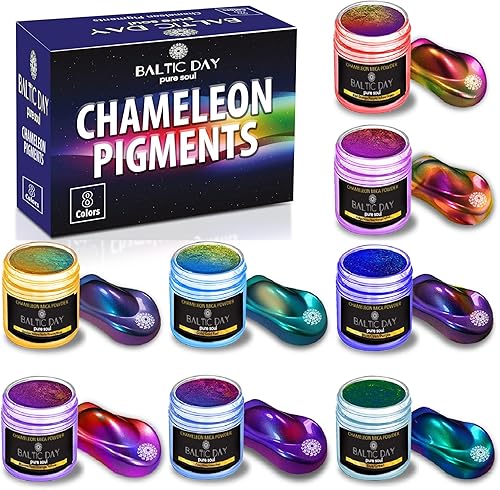
This set holds 8 chameleon mica powders, each jar 3 grams, covering a range of color-shifting shades. The listing’s case is the shift itself: powders that change hue and shimmer depending on the angle. It’s aimed at epoxy jewelry, tumblers and paintings. The seller also flags something useful — some chameleon colors look identical in the jar because of the chemicals involved, and the unique effect only appears once applied.
Strengths:
- 8 color-shift powders in one set
- Listed as highly pigmented and strong
- Suits jewelry, tumblers and paintings
- Works in resin, soap, candles and nail polish
- Small jars suit small, detailed projects
Trade-offs:
- 3g per jar, small for large pours
- Colors can look alike until applied
You’d use it on jewelry, small castings and accents where a few grams stretches far. The listing’s note about similar-looking jars is worth heeding, because you’d otherwise assume a wrong shipment arrived. What you gain is a shift effect that flat metallic powders don’t produce, and what you accept is that you’ll be buying small and working small.
| Best for | Why |
|---|---|
| Epoxy jewelry makers | Color shift suits small pieces |
| Tumbler decorators | Shifting shimmer draws the eye |
| Detail artists | Small jars match fine work |
8. Spartan Epoxies Metallic Pigment Powder

Best for: Homeowners and contractors coating garage or basement floors
Spartan Epoxies sells this pigment in 30 colors, with two jar sizes: 4oz for 1 gallon of clear epoxy and 12oz for 3 gallons. That coverage guidance is the whole point — this is a flooring product, not a craft powder. The listing says it’s made in the USA with high-quality raw materials and works with any clear epoxy, including the brand’s own ClearLX. It’s built for garages, basements and commercial spaces where metallic epoxy floors are a growing choice.
Strengths:
- 30 colors aimed at metallic epoxy floors
- Jar sizes matched to 1 or 3 gallons of epoxy
- Listed as compatible with any clear epoxy
- Made in the USA with quality raw materials
- Suits garages, basements and commercial floors
Trade-offs:
- Sized for large pours, not small crafts
- Flooring use assumes you’re mixing full gallons
Buying this means you’re committing to a floor-sized project, and the jar size you pick has to match your epoxy volume or you’ll run short mid-pour. The listing pairs it with ClearLX, a low VOC, USDA-approved food-safe formula, which matters if the floor is in a home. Week to week, you’d be mixing by the gallon and working fast before cure. What you stop worrying about is whether the jar covers the square footage of a garage.
| Best for | Why |
|---|---|
| Garage floor coatings | Jar sizes match gallon volumes |
| Basement and shop floors | Built for large metallic pours |
| Contractors | 30 colors across big jobs |
Also Worth Considering
Three more options are worth a look if none of the above fits. Upstart Pigment Powder pcs Set is an 18-piece mica metallic pigment set, a middle ground between the small craft jars and the large flooring tubs. Metallic Additive Pigment Powder Epoxy comes in a 32 oz Oyster tone and is listed for epoxy resin, casting resin, floors and even makeup, so it’s aimed at big-volume work in a single neutral shade. PCP Metallic Mica Powder Epoxy is a 2oz Gun Metal powder listed for bar and restaurant floors, with smooth mixing and a cosmetic-grade claim for soap, candles and nail art.
Side by Side
The table below lines up these pigments on the things that decide a purchase: what the powder is made from, how many colors you get, the jar or bottle size, and the job each one is built for.
How to Judge One of These
What the Pigment Is Actually Made From
The single biggest split in this category is mica versus true metal. Mica is a mineral powder that gives a pearlescent shimmer — it reflects light and can stay translucent depending on how much you add. True metallic pigments, like the aluminum in Sterling Lining or the zinc and copper in Gilded Gold, are actual metal particles that produce an opaque, metal-looking finish. Neither is better; they do different jobs. If you want a surface that reads as solid brushed metal, mica won’t get you there no matter how much you add. If you want depth and light play, a true metallic can look flat by comparison. Before ordering, read the listing’s own description of the base material and decide which finish you actually want on the cured piece. That one check saves a wasted pour.
How Many Colors You Really Need
Color count is the number buyers fixate on, and it’s often the one that matters least. A 48-color set sounds like more value than a 5-color set until you realize you’ll use four or five shades for most projects and the rest will sit. Large sets also ask for storage and labeling, because metallic powders look alike in the jar. The honest question is whether you’re exploring or executing. If you’re still finding your palette, a wide set earns its place. If you know you want gold and silver, a small focused set gets you working with less to organize. Before ordering, count how many colors you’ve actually reached for in the last few projects. That number is your real requirement.
The Jar Size That Matches Your Pour
Jar size is the spec that quietly decides whether a pigment works for you. A tiny chameleon jar is perfect for jewelry and hopeless for a tabletop. A jar sized for a gallon of clear epoxy is the reverse. The listing usually tells you the intended scale — some name the exact epoxy volume the jar covers. That’s the number to trust, because it’s the seller telling you what the product is for. If a listing gives no coverage guidance, judge by the jar weight against the size of your project. Before ordering, measure your pour area and estimate your epoxy volume first. Buying pigment before you know your volume is how people end up short mid-pour.
The Selling Point That Rarely Earns Its Place
Every listing here leads with something eye-catching — color shift, floating effects, 48 shades — and that headline is usually the least important part of the purchase. Color-shift powders only shift at certain angles and in certain light, so a piece can look plain on a shelf. Floating effects depend entirely on your pour technique, not the powder alone. A huge color count is only useful if you’ll use the colors. The features that actually decide whether you’re happy are duller: does the powder disperse evenly, does it stay suspended in your resin, and does the tone match what you pictured. Before ordering, ask whether the headline feature shows up in the kind of project you actually make. If it doesn’t, you’re paying attention to the wrong line.
Closing
For most people, the Rolio Premium Mica Powder set covers the everyday need — 24 colors, cosmetic-grade, and small enough to store without a dedicated shelf. If your need is unusual, the Spartan Epoxies Metallic Pigment is the outlier pick, because it’s sized for gallons of clear epoxy and built for floors rather than crafts. Before you order anything, measure your project and estimate your epoxy volume, then match the jar size to it.


