

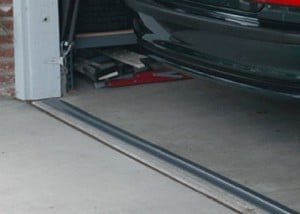
Finish epoxy garage floor edges and door thresholds by cutting the coating at the wall line, then sealing the gap with a flexible urethane caulk. Most edge failures come from one thing: the slab meets the wall or driveway with a moving joint, and rigid epoxy cracks along it. Cut a clean line first, caulk second.
Why edges and thresholds fail
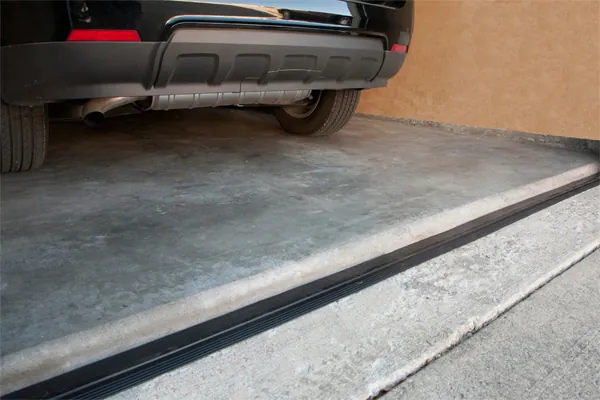
Concrete moves. Your slab expands and shrinks with temperature, and it also lifts and drops slightly as the ground under it shifts. Walls and driveway aprons move on their own schedule.
Water makes it worse. If the epoxy stops short of the concrete edge, water gets under it and pushes it up from below. Freeze-thaw cycles speed that up in cold states.
There’s also a mechanical cause. Tires, snow shovels, and floor jacks roll right over the threshold edge. A thin, feathered edge of epoxy can’t take that load, so it breaks off in flakes.
How to finish epoxy garage floor edges and door thresholds
Here’s the full process, start to finish. Work in this order, and don’t skip the prep — the edge is where prep matters most.
- Grind or acid-etch the concrete right up to the wall and the threshold. Stop about 1/4 inch from the wall plate. You want a rough, open surface, not a smooth one.
- Check for moisture. Tape a square of plastic sheet to the slab for 24 hours. If condensation forms under it, fix the moisture problem before you coat anything.
- Fill cracks and control joints with an epoxy crack filler, then let it cure fully.
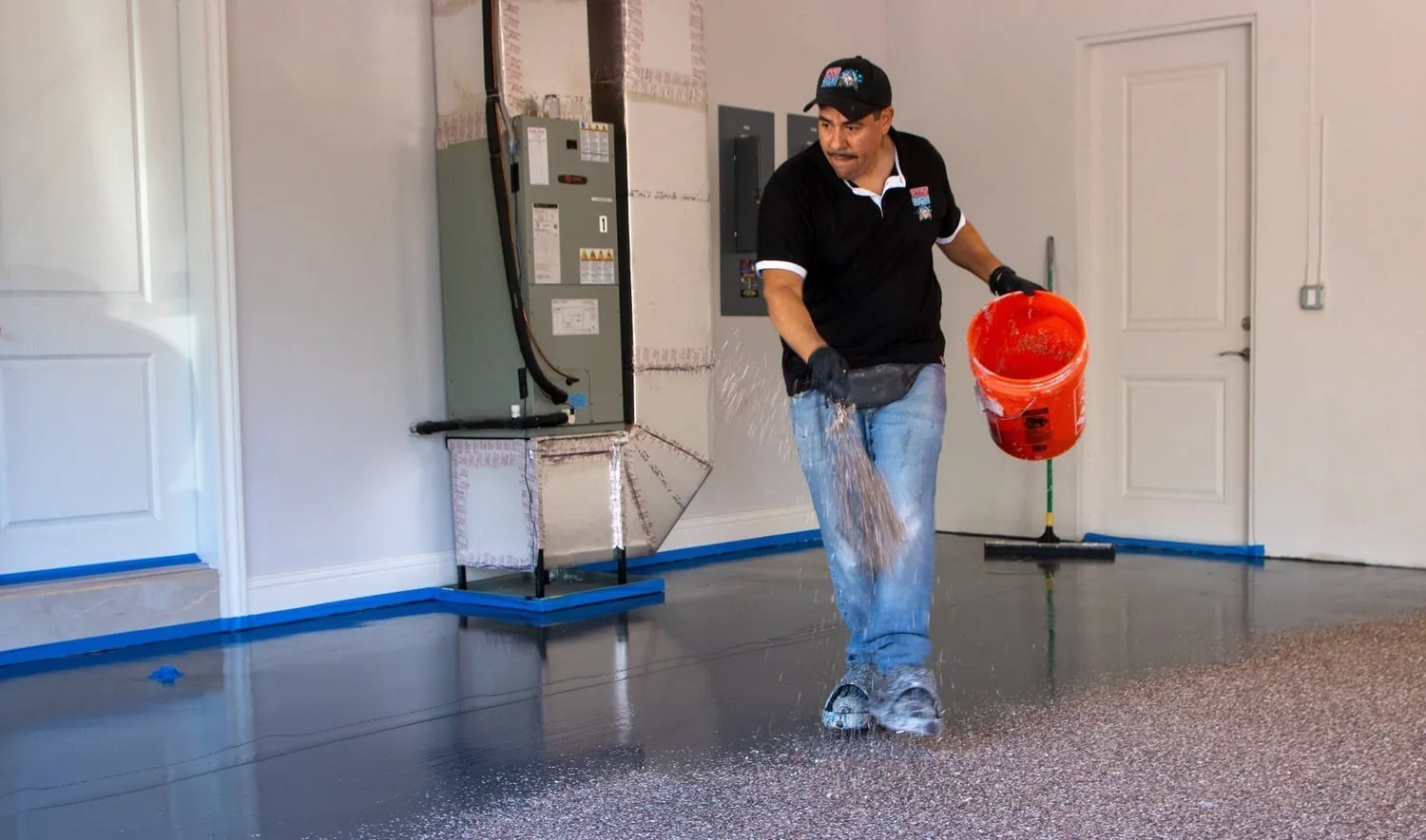
- Apply your base coat and flake or color coat as normal, rolling the epoxy out to the edge but not past it.
- Let the base coat cure — check your product’s data sheet, because cure time varies with temperature.
- Cut a clean edge line along the wall and threshold with a razor or a grinder before you caulk.
- Caulk the joint with a flexible urethane or polyurea sealant, not epoxy.
- Topcoat the whole floor, including the caulked edge, with your clear coat.
That order matters. Caulking before the base coat cures means you’ll drag wet epoxy into your sealant line.
Cut a clean edge line before you caulk
This fix is for anyone whose epoxy already ran to the wall and looks ragged, or who’s about to coat and wants a clean border. The goal is a straight, controlled line instead of a feathered edge that breaks off.
Wait until the base coat is dry enough to walk on but not fully hard. In a cold garage, give it longer. Then run a sharp razor blade or a small grinder along the wall base and the threshold, keeping the cut about 1/4 inch away from the wall itself.
That 1/4 inch gap is your expansion space. It gives the slab room to move without cracking the coating.
Sweep or vacuum the dust out of the cut. You’ll know it worked when the edge line looks straight and the epoxy stops cleanly instead of thinning out to nothing. If the line crumbles as you cut, the epoxy isn’t cured enough — wait a few more hours and try again.
Related Article: How to Make an Epoxy Garage Floor Less Slippery
Seal the joint with flexible caulk
This is the step most people skip, and it’s the one that actually saves the edge. Rigid epoxy can’t move; a urethane or polyurea sealant can stretch and come back.
Pick a sealant labeled for concrete joints and exterior use. Squeeze a bead into the gap you cut, then tool it smooth with a caulk tool or a gloved finger dipped in mineral spirits.
For a standard 1/4 inch gap, a bead about the width of the gap works. For wider gaps, use a backer rod first so the sealant doesn’t sink into the void. Let it skin over per the tube’s directions.
At a door threshold, run the sealant along the full width where the slab meets the apron or the door sill.
You’ll know it worked when the sealant stays flexible and the epoxy edge doesn’t lift when you press on it.
Fix a threshold that keeps chipping
This is the harder case, and it’s worth doing when the threshold takes real traffic — cars, snow shovels, heavy footfall. If your threshold is inside a garage that never sees weather or wheels, skip it and save the money.
The fix is a transition strip or a concrete ramp at the door. A metal or rubber threshold strip screws or anchors into the slab and covers the epoxy edge completely, so nothing rolls directly over the coating. A small concrete ramp does the same job where the slab sits lower than the driveway.
This work needs the right anchors and, for a concrete ramp, mixing and finishing skills. If the slab is structural or the door is a fire-rated assembly, call a licensed contractor — cutting or anchoring into a fire door threshold can void its rating.
You’ll know it worked when tires and shovels cross the threshold without catching the coating. If the strip rocks or lifts after a season, the anchors weren’t long enough for your slab.
What not to do at the edge
Some popular advice makes edges worse. Here’s what to avoid.
- Don’t run epoxy all the way into the wall. It looks fine for a month, then cracks along the wall line because the slab can’t move. Leave that 1/4 inch gap.
- Don’t caulk with more epoxy. Epoxy is rigid, so it cracks at the same joint it was supposed to protect. Use a flexible sealant.
- Don’t feather the edge to nothing. A paper-thin epoxy edge flakes off under a tire. Cut it square and seal it.
- Don’t skip the moisture test. If water is coming up through the slab, no edge treatment will hold. Fix the moisture first.
- Don’t coat a damp or dirty threshold. Dust and moisture stop the epoxy from bonding, and the whole edge lifts in sheets.
How to stop edge problems next time
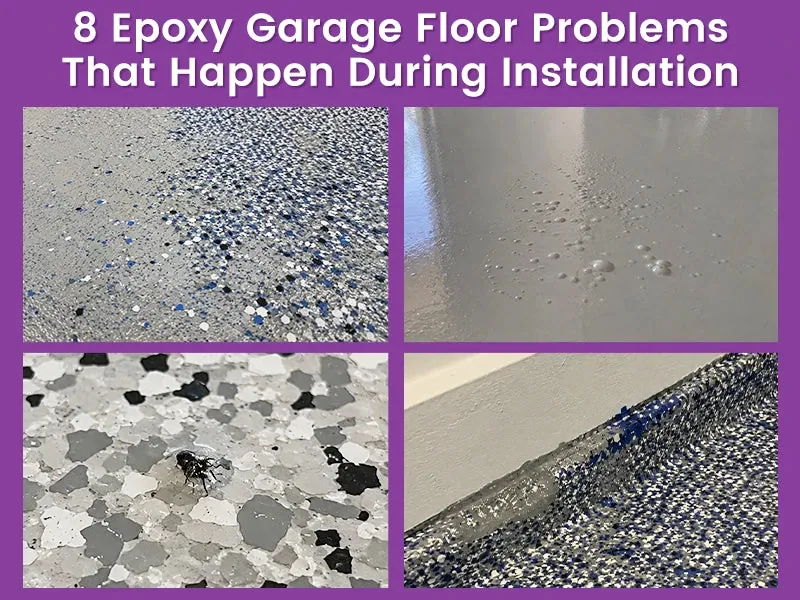
A little planning before you pour saves the whole edge. Match what you’re doing now to what actually works.
| If you’re doing this | Do this instead | Why |
|---|---|---|
| Rolling epoxy into the wall | Stop 1/4 inch short, then caulk | Gives the slab room to move |
| Using epoxy as your joint filler | Use urethane or polyurea sealant | Flexible sealant stretches, epoxy cracks |
| Coating over a wet slab | Run the plastic-sheet moisture test first | Trapped moisture pushes the coating off |
| Leaving a thin feathered edge | Cut a square edge and seal it | Thin edges break off under tires |
| Ignoring the threshold | Add a transition strip or ramp | Takes the traffic load off the coating |
| Caulking before the base coat cures | Wait 12–24 hours at 70°F | Wet epoxy smears your sealant line |
Frequently asked questions
Can you epoxy right up to the garage wall?
No, leave about a 1/4 inch gap between the epoxy and the wall. That gap lets the slab expand and contract without cracking the coating. Fill the gap with a flexible urethane or polyurea sealant after the base coat cures. Running epoxy tight to the wall is the most common reason edges crack in the first year.
Why is my epoxy peeling at the garage door?
Peeling at the door usually means water is getting under the edge. Rain and melting snow sit at the threshold, and if the epoxy stops short or the joint isn’t sealed, moisture works underneath. A moisture problem in the slab makes it worse. Seal the threshold joint and test your slab for moisture before recoating.
How long should I wait before caulking the edge?
Wait 12 to 24 hours at 70°F after the base coat, or until you can walk on it without leaving marks. Cold weather stretches that out. Check your product’s data sheet, since cure times vary by brand and temperature. Caulking too early drags wet epoxy into your sealant line.
Is it safe to grind the concrete edge myself?
Yes, for a standard garage slab, as long as you wear a respirator, eye protection, and hearing protection. Silica dust is the real risk, so use a grinder with a dust shroud and vacuum. If the slab is structural, or the door is fire-rated, stop and call a licensed contractor instead — cutting there can void a rating or weaken the slab.
What happens if I use epoxy to fill the edge gap?
It cracks. Epoxy cures hard and rigid, so it can’t stretch when the slab moves against the wall or threshold. The joint opens, the epoxy splits, and water gets in. A flexible urethane or polyurea sealant does the opposite — it stretches and returns, which is exactly what a moving joint needs.
How often should I check the threshold sealant?
Check it once a year, ideally before winter. Look for cracks, gaps, or sealant pulling away from the concrete. A urethane bead can last a long time in a garage, but sun, salt, and freeze-thaw wear it down faster. Reapply a fresh bead when you see gaps — it’s a cheap fix that protects the whole edge.
Can I recoat just the edges without redoing the floor?
Yes, if the rest of the floor is still bonded. Cut away the loose epoxy, grind the bare concrete, clean it, and reapply base coat just on that strip. Then caulk the joint and topcoat the repair. Blend the new coating into the old with a light sanding so the patch doesn’t show a ridge.
Conclusion
The edge is the part of your floor that takes the most abuse and gets the least attention. Cut a clean line, leave room for movement, and seal the joint with something flexible.
Do that, and your epoxy will hold up at the wall and the door for years instead of one season.


