

No, you should not use standard epoxy floor paint directly on wood substrate surfaces.
You might be eyeing your wooden workshop floor or basement subfloor right now. It is easy to look at those spaces and wonder if you can achieve that high-gloss, industrial look you see in professional garages.
It is a super common DIY question: can you do epoxy on wood floors? While the appeal of a glass-like, durable finish is strong, wood and epoxy are fundamentally different materials. They simply do not play well together!
The short answer is no, you should not use standard epoxy floor paint directly on wood substrate surfaces. While it might seem like a quick shortcut to a tough finish, wood is a dynamic, organic material.
It constantly expands and contracts with humidity changes. Because standard epoxy is rigid and non-porous, it cannot move with the wood. This almost always results in cracking, peeling, or a total epoxy floor paint failure over time.
Why Wood and Epoxy Don’t Mix?
Standard epoxy garage floor kits are engineered specifically for the stable, mineral-based surface of concrete. Wood behaves very differently. Let’s look at how they stack up:
| Feature | Concrete Floor | Wood Floor |
| Stability | Highly stable; minimal movement | Dynamic; expands and contracts |
| Porosity | Uniformly porous (after prep) | Inconsistent; prone to moisture |
| Bonding | Excellent mechanical bond | Poor; movement breaks the bond |
| Durability | Long-lasting barrier | Prone to cracking if rigid |
Epoxy Floor Paint on Wood: Moisture and Movement Problem
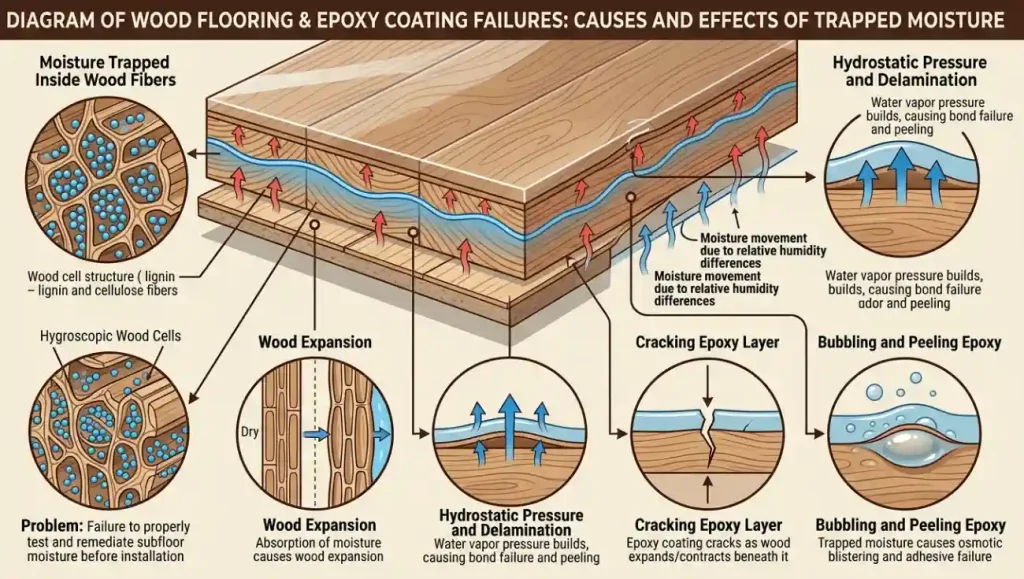
Wood acts like a giant sponge, absorbing and releasing moisture from the air. When you coat wood with a hard, non-porous epoxy resin, you are essentially sealing that moisture inside the wood fibers.
As the wood naturally expands during humid seasons, the rigid epoxy layer cannot stretch to match it. This internal tension forces the epoxy to crack or pop right off the ground!
Furthermore, you might be asking, can you epoxy over stained wood? Even if the wood is stained, it still contains natural oils and resins. These oils can prevent a proper chemical bond, leading to premature peeling regardless of the stain’s color or type.
Related Article: Can You Paint Over Epoxy Floor Coating?
The Better Alternatives for Wood Floors
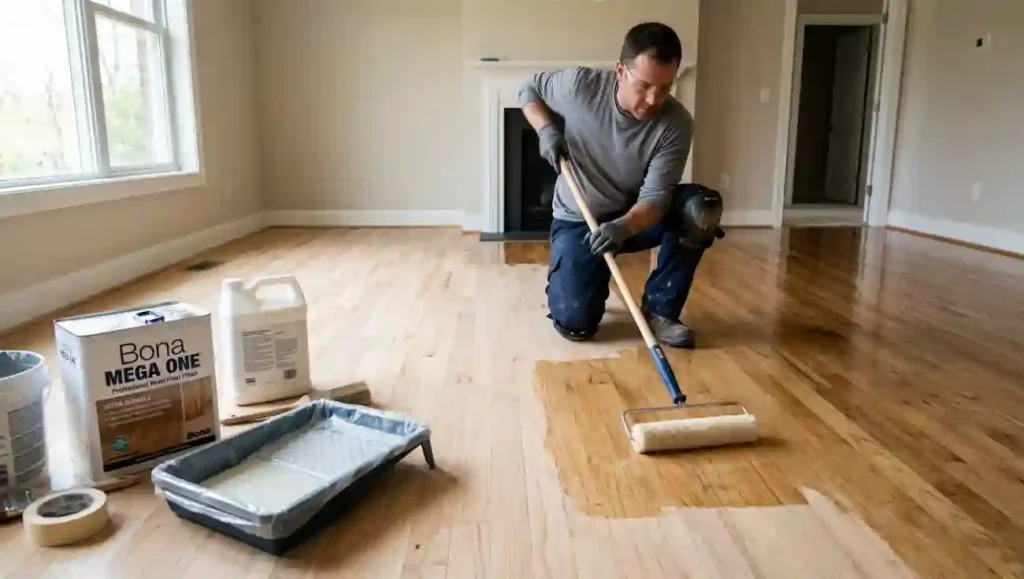
If you want a protected, high-performance finish for your wooden floors, don’t force a concrete product onto them. Instead, use systems specifically formulated for the unique characteristics of wood:
- High-Traffic Polyurethane: Unlike epoxy, an oil-based or water-based polyurethane finish provides a durable, hard-wearing coat that stays slightly flexible. This allows it to move with the wood instead of cracking.
- Floor Enamel Paint: These are specifically formulated for wood flooring. They are much tougher than standard wall paint but retain enough flexibility to withstand heavy foot traffic.
- Flexible Wood Coatings: If you absolutely want that “liquid glass” look, look for specialized, flexible epoxy formulas meant for wood furniture. But be aware that these are usually expensive and require very intense surface preparation.
Conclusion: Build a Floor That Lasts
So, can you do epoxy on wood floors successfully? Not with standard garage kits! Save yourself the weekend headache and skip the concrete products. By picking a tough, flexible polyurethane or specialized wood floor enamel, you will get a beautiful, glossy finish that moves with your home instead of peeling off.
What area are you planning to upgrade next? Get your tools ready, skip the standard epoxy traps, and build a wooden floor you can truly be proud of!
Frequently Asked Questions
Can I use a bonding primer to make epoxy stick to wood?
No, you shouldn’t. Even with a high-adhesion primer, the fundamental issue of wood expansion remains. The wood will eventually move enough to break the bond of any rigid, concrete-grade epoxy coating.
What is the best way to get a glossy finish on wood?
For the most durable, glossy, and professional-looking wood floor, I highly recommend using a high-quality, oil-based polyurethane. Apply it in multiple thin coats with a light sanding epoxy floor routine in between layers. It is much easier to maintain!
Can I use epoxy for small, non-moving wooden projects?
Yes! If you are working on a small table, a workbench, or a non-structural piece of crafts, you can use specialized “tabletop” epoxy resins. These are formulated to handle a bit of wood’s natural movement, but they are still not suitable for large floor areas that experience heavy foot traffic.
7 comments
Comments are closed.