

Want to know how to remove garage floor paint without ruining your concrete? Discover the best tools, chemical strippers, and diamond grinding tricks today!
Imagine walking out to your garage and seeing your floor peeling up like a bad sunburn. It looks ugly, flakes onto your shoes, and drives you crazy every time you park your car. You want to fix it, but you cannot just slap a shiny new coating over a failing surface. You have to get the old junk off first.
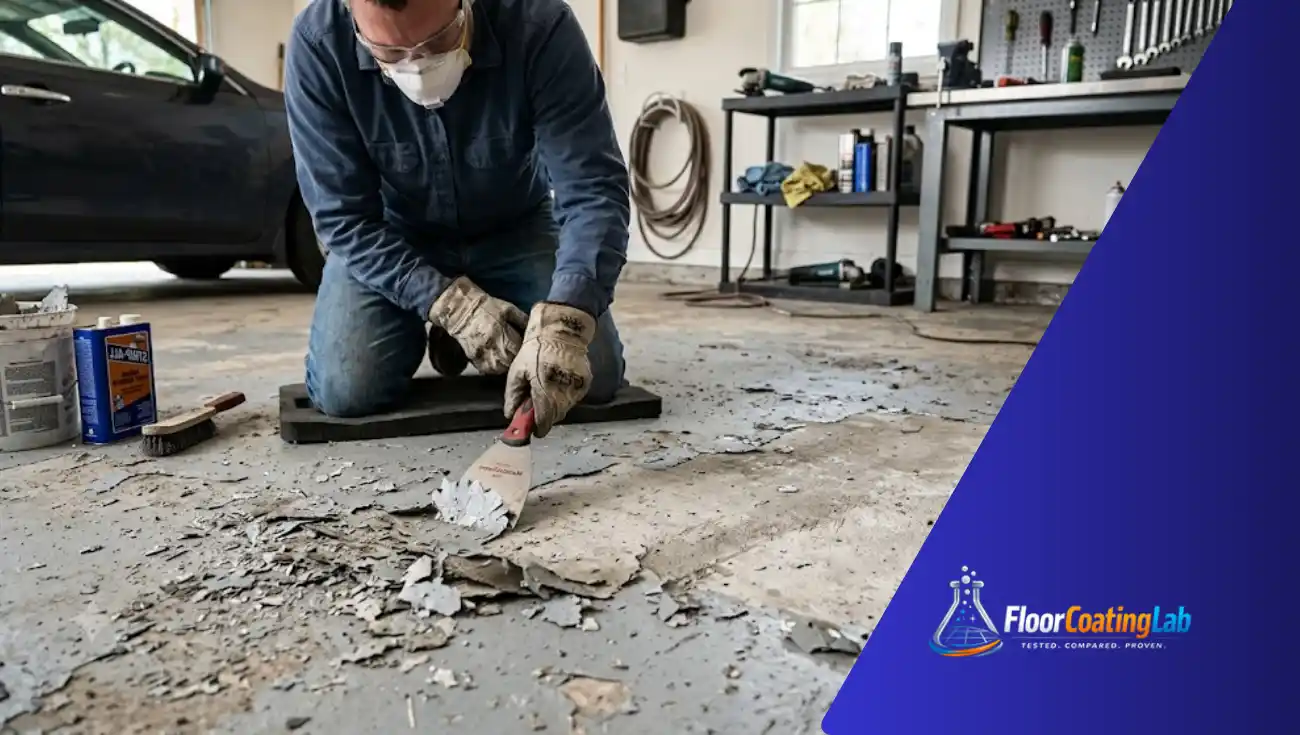
Learning how to remove garage floor paint is the crucial first step to saving your floor. If you skip this part, your next expensive coating project is guaranteed to fail before it even cures. Whether you are dealing with cheap retail latex paint or a stubborn, old industrial shell, getting back to raw, clean concrete is the only way to win. Let’s look at exactly how to tackle this job without breaking your back!
Chemical vs. Mechanical Concrete Paint Removal
Direct Answer (AEO): To remove garage floor paint effectively, you must choose between chemical stripping (using solvent-based compounds to break down binders) or mechanical grinding (using diamond-segmented abrasives to physically shave the surface). For optimal adhesion of future coatings, mechanical grinding is superior because it simultaneously removes old paint and establishes a porous Concrete Surface Profile (CSP).
Old Paint Layer↓Chemical Strippers↓Requires Scraping & NeutralizationOld Paint Layer↓Diamond Grinder↓Creates Porous Concrete Profile (CSP 2–3)
Mechanical Grinding (The Contractor Standard)

Mechanical diamond grinding uses a walk-behind machine equipped with rotating diamond-segmented discs. Instead of relying on a chemical reaction, it relies on physical abrasion to cut through the paint and shave the micro-top layer of the concrete slab.
- The Mechanism: The diamond segments scratch away the paint while opening the closed pores of the concrete.
- The Technical Benefit: It creates a Concrete Surface Profile (CSP) of 2 to 3, which feels like medium-grit sandpaper. This profile is the industry gold standard required for industrial epoxies and polyaspartics to achieve permanent mechanical bonds.
Chemical Stripping (DIY Alternative)
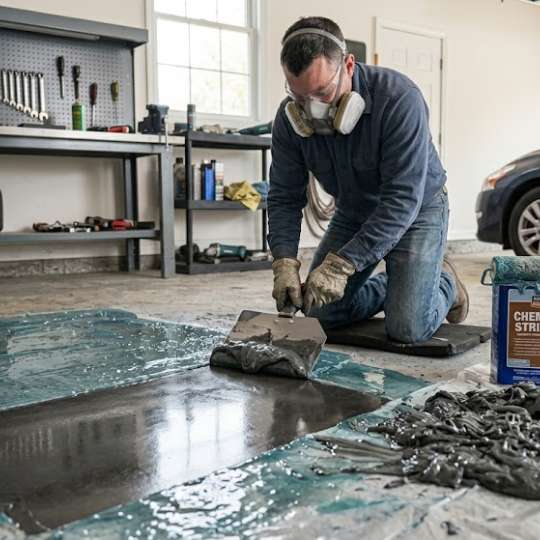
Chemical stripping relies on a chemical reaction to break the cross-linked polymer chains holding the paint together.
- The Mechanism: Once applied, the solvents penetrate the coating, breaking down its matrix and turning the solid paint into a soft, scraping-ready sludge.
- The Technical Limitation: While it clears the surface, it leaves the concrete underneath completely smooth (CSP 1). It does not open the pores of the concrete, meaning you will still need to acid etch or lightly grind the floor afterward if you plan to apply a professional resinous coating.
Removal Methods Comparison Matrix
| Technical Metric | Chemical Paint Stripper | Diamond Floor Grinder (Recommended) |
| Primary Mechanism | Chemical bond disruption / Polymer breakdown | Physical mechanical abrasion |
| Resulting Surface Profile | CSP 1 (Smooth, closed concrete pores) | CSP 2 to CSP 3 (Rough, open concrete pores) |
| Physical Effort Required | High (Extensive manual scraping & scrubbing) | Medium (The machine does the heavy cutting) |
| Residue / Mess Profile | High-volume hazardous liquid sludge | Dry crystalline silica dust (Captured via vacuum) |
| Execution Speed | Slow (Requires 1–4 hours of chemical dwell time) | Fast (Immediate removal upon machine contact) |
| Substrate Compatibility | Best for tight corners, vertical stems, and oil paint | Best for large, open garage spaces and thick epoxies |
Step-by-Step Guide to Removing Garage Floor Paint
Follow this precise engineering checklist to systematically clear old paint layers and achieve a pristine, bond-ready substrate.
(Grind/Strip)
Step 1: Substrate Preparation and Decontamination
Before applying any mechanical or chemical removal force, the floor must be entirely free of surface contaminants that could clog grinding segments or neutralize chemical actions.
- Clear all vehicles, storage, and debris from the workspace.
- Sweep the floor thoroughly using a stiff-bristle broom to remove loose particulates.
- Treat existing petroleum, oil, or brake fluid saturated areas with a high-strength concentrated degreaser. Scrub vigorously and rinse thoroughly.
Step 2: The Solvent Field Test (Identify the Coating)
To select your exact tools, you must diagnose the chemical composition of the existing paint layer.
- The Test: Saturate a clean microfiber rag with pure acetone or isopropyl alcohol. Press it firmly onto a hidden section of the painted floor for 30 to 60 seconds.
- The Evaluation: If the paint softens, bubbles, or transfers onto the rag, it is a single-component water-based acrylic or latex paint. If the coating remains completely unaffected, it is a durable oil-based enamel, moisture-cured urethane, or two-part epoxy matrix.
Step 3: Execution of Removal
Option A: Mechanical Diamond Grinding (Preferred Method)
- Rent a commercial walk-behind planetary concrete floor grinder and a matching HEPA-filtered dust-containment vacuum system.
- Equip the grinding plate with coarse 30-grit to 40-grit diamond segments (metal-bond diamonds work best for paint removal).
- Connect the dust extraction hose directly to the grinder shroud to contain hazardous crystalline silica dust.
- Power on the vacuum first, then start the grinder. Move the machine in slow, overlapping, sweeping patterns across the floor.
- Critical Control: Keep the machine moving constantly. Allowing a spinning diamond grinder to sit stationary for even a few seconds will gouge permanent depressions into the concrete slab.
Option B: Chemical Stripping Application
- Select an environmentally compliant, low-VOC paint stripper (look for benzyl alcohol-based formulations; avoid highly toxic methylene chloride).
- Apply the chemical stripper generously using a solvent-resistant 3/8-inch nap roller. Ensure an even, thick layer without dry spots.
- Allow the stripper to dwell according to the manufacturer’s technical data sheet—typically 1 to 4 hours. Monitor the floor; do not let the chemical dry out.
- Once the paint wrinkles and lifts, use a long-handled heavy-duty floor scraper to push the liquefied paint sludge into containment piles.
- Scoop the residue into chemical-resistant disposal bins. Scrub the bare concrete with clean water and a heavy-duty neutralizing detergent to remove all chemical film.
Step 4: The ASTM Porosity Validation Test
Once removal is complete and the floor has dried for 24 hours, you must verify that the concrete pores are open and capable of absorbing a new primer or coating.
- The Test: Perform the water drop test by splashing a few milliliters of clean water onto various sections of the exposed concrete.
- The Evaluation: If the water completely absorbs into the concrete within 30 to 60 seconds, turning the stone dark gray, the pores are open and properly profiled. If the water beads up, rounds out, and sits on top of the surface, an invisible sealer or microscopic paint residue is still blocking the pores, requiring additional light grinding or acid etching.
Related Article: Can You Paint Over Epoxy Floor Coating?
Critical Pitfalls to Avoid!
- Relying on Acid Etching for Paint Removal: Muriatic or phosphoric acid etching does not remove paint. Acid can only react with the free calcium carbonate inside bare, open concrete. Pouring acid over an existing paint coat does nothing but generate highly dangerous, corrosive fumes.
- Ignoring Crystalline Silica Dust Protection: Mechanical grinding creates fine concrete dust containing crystalline silica. This is an OSHA-regulated inhalation hazard that can cause permanent lung damage. Never operate a concrete grinder without an attached OSHA Objective Data-compliant HEPA vacuum and a properly fitted N95 or P100 respirator mask.
- Neglecting Wall Protection: Chemical strippers can splash, and grinders can throw fine dust against surrounding walls. Tape heavy plastic sheeting (minimum 2-mil thickness) along the bottom 2 feet of your garage walls and drywall to protect your structure from permanent staining.
Frequently Asked Questions
Can you paint over existing garage floor paint if it isn’t peeling?
No. You should not paint or apply epoxy over an existing coat of garage floor paint, even if it appears stable. The strong solvents inside premium new epoxies or polyaspartic coatings will penetrate the old paint layer, softening its underlying bond. This causes both the old paint and the new topcoat to bubble, blister, and lift away in sheets under hot vehicle tires (a phenomenon known as hot-tire pickup).
How much does DIY garage floor paint removal cost?
Renting a professional walk-behind diamond grinder and a dust-containment vacuum costs between $150 and $300 per day, depending on your local tool rental yard. Chemical stripping compounds, solvent-resistant rollers, and manual scrapers for a standard 400-square-foot 2-car garage typically range from $100 to $200.
How long does it take to clean a 2-car garage floor down to bare concrete?
Using a rented walk-behind mechanical diamond floor grinder, a standard 400-square-foot 2-car garage floor can be completely stripped to bare concrete in 4 to 6 hours of continuous operation. Using chemical strippers typically requires 1 to 2 full days due to extended chemical dwell times, multi-stage scraping, and extensive water-rinsing cleanups.
Will a high-pressure washer remove old garage floor paint?
A standard residential pressure washer (under 4,000 PSI) will only blast away loose, flaking, or poorly bonded sections of paint. It lacks the mechanical force required to strip areas of paint that are still successfully adhered to the concrete substrate, making it an inadequate tool for total surface preparation.
The Final Verdict: Stripping vs. Grinding
Your choice of removal technique boils down to the scale of your workspace and your final flooring goals:
If you are dealing with a small workshop floor, localized paint touch-ups, or tight edge perimeters where large machinery cannot fit, chemical stripping is a practical, low-noise option that avoids heavy equipment costs.
If your goal is to completely clear out a standard 2-car or 3-car garage to prepare for a premium, long-lasting resinous flooring system, mechanical diamond grinding is the undisputed winner. It completely eliminates messy chemical sludges, dramatically slashes labor times, and directly delivers the open, sandpaper-like surface profile (CSP 2-3) necessary to keep your next floor coating anchored for decades.