

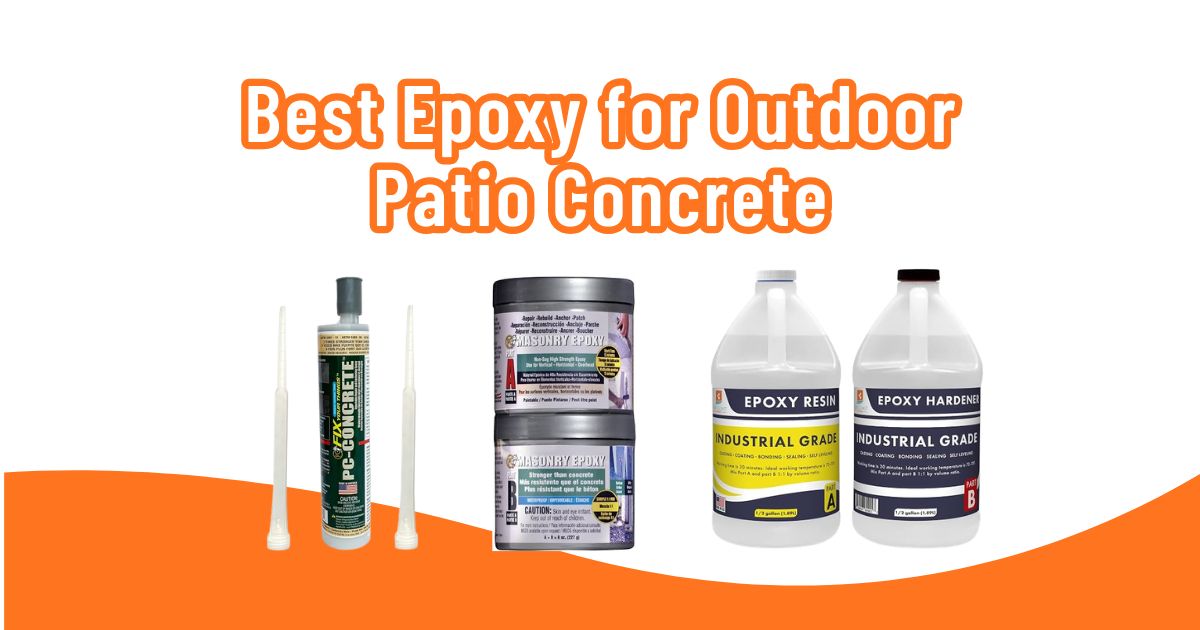
Choosing the best epoxy for outdoor patio concrete comes down to one question: what are you asking the product to do? Some of these products glue loose material back together, some lock gravel into a solid, walkable surface, and others coat a whole slab in a fresh color. Every pick below is judged on the same three things: what it’s strong at, what it gives up, and what living with it would ask of you.
As an Amazon Associate, we earn from qualifying purchases. This post contains affiliate links – if you buy through them, we may earn a commission at no extra cost to you.
1. PC Products PC-Concrete 72561

Best for: Small anchoring and crack repair jobs
Strengths:
- Two-part epoxy paste for anchoring and crack repair
- Comes in a cartridge for controlled application
- Gray color blends with concrete
- 8.6 oz size suits small, targeted jobs
Trade-offs:
Living with this one would mean working in small sections, since the listing gives no cure window to plan around. If your repair is a hand-sized patch or a set of anchor holes, that’s likely fine.
| Best for | Why |
|---|---|
| Anchor bolt setting | Paste format suits vertical holes |
| Small crack patches | Cartridge controls the mix |
| Spot repairs on patios | Gray blends with concrete |
2. PC Products PC-Masonry Epoxy Adhesive Paste

Best for: Filling cracks in worn masonry
This is a two-part masonry repair epoxy adhesive paste that replaces missing concrete or fills cracks on deteriorating masonry, sold as 8 oz in two cans. The listing stakes its case on a few specific things: it resists moisture and can go on wet or dry surfaces, it works indoors and outdoors across an application range of 35 to 115 degrees F, and it holds a service range of -20 to +200 degrees F. It’s also non-sagging, so it stays put on horizontal and overhead surfaces, and it can be painted, stained, or machined once fully cured.
Strengths:
- Applies to wet or dry surfaces
- Non-sagging on horizontal and overhead work
- Application range of 35 to 115 degrees F
- Service range of -20 to +200 degrees F
- Can be painted, stained, or machined after curing
Trade-offs:
- You mix it yourself from separate containers
The wet-surface claim is the one that changes your day. Living with it asks patience at mixing time. You’d stop worrying about the weather window, since 35 to 115 degrees F covers most of the year in most of the country. This isn’t for someone who wants to open a tube and squeeze — it’s a mixing job.
| Best for | Why |
|---|---|
| Damp crack repair | Bonds to wet surfaces |
| Overhead patching | Non-sagging paste stays put |
| Cold-weather work | Applies down to 35 degrees F |
3. J-B Weld 6 Minute Set Epoxy KwikWeld

Best for: Fast repairs across mixed materials
J-B Weld KwikWeld is a fast-setting version of the Original Cold Weld epoxy system. The listing says it sets in 6 minutes and cures in 4 to 6 hours, with a tensile strength of 4360 PSI. It comes in a syringe with a 1:1 mix ratio and a re-sealable cap.
Strengths:
- Sets in 6 minutes, cures in 4 to 6 hours
- Tensile strength of 4360 PSI
- 1:1 mix ratio in a re-sealable syringe
- Bonds metal, plastic, PVC, wood, concrete, ceramic, tile, and fiberglass
- Mixing tray and stir stick included
Trade-offs:
- Dark grey color won’t match light concrete
- 6-minute set leaves little working time
- Sold as a pack of two, not a single unit
Six minutes is the whole story here. On a patio, that suits a loose tile edge or a metal bracket better than a long crack.
| Best for | Why |
|---|---|
| Loose tile edges | Sets in 6 minutes |
| Metal bracket repairs | Bonds metal and concrete |
| Mixed-material fixes | Wide surface application list |
4. Akona Fast-Setting Anchoring Epoxy

Best for: Setting bolts, dowels, and rebar
Akona’s fast-setting anchoring epoxy is an 8.45 oz tube of high-strength, moisture-tolerant concrete anchor epoxy. The listing says it sets in 12 minutes and is fully dry in 16 hours, applies from a no-mess tube, and suits concrete floors, walls, driveways, stairs, anchor bolts, dowels, and rebar in concrete and masonry. It’s gray to match existing surfaces.
Strengths:
- Sets in 12 minutes, fully dry in 16 hours
- Moisture tolerant and resists chemicals and solvents
- No-mess application tube
- Gray color matches existing concrete
- Listed for anchor bolts, dowels, and rebar
Trade-offs:
- The tube size limits how many anchors one tube covers
- No coverage figure is stated
The fast set time is what shapes how you’d work. You’d drill, clean the hole, and set your anchors in small batches rather than mixing one big run. The gray color means the repair disappears into the slab instead of announcing itself. This isn’t for someone filling a wide crack — it’s built for holes and embedded hardware.
| Best for | Why |
|---|---|
| Anchor bolt setting | Fast 12-minute set |
| Damp drilled holes | Moisture tolerant formula |
| Rebar and dowel work | Listed for embedded hardware |
5. Industrial Grade 1:1 Epoxy Resin

Best for: Clear glossy coating on patio surfaces
This is an industrial-grade epoxy resin kit from East Coast Resin, split evenly between resin and hardener. The listing stakes its case on clarity and finish: it’s built to go on smooth and dry evenly, eliminating crawling, trickling, craters, and “fish eyes.” It’s described as UV-resistant, scratch-resistant, and moisture-resistant, with a minimal-odor formula that needs no mask. Surfaces coated with it are described as safe for food to touch. Instructions are included, and the listing positions it for bonding, sealing, casting, coating, filling, and gluing.
Strengths:
- Equal parts resin and hardener
- Described as UV, scratch, and moisture resistant
- Minimal odor, no mask required per listing
- Coated surfaces described as food safe
- Detailed instructions included in each kit
Trade-offs:
- Clear finish shows the surface underneath
- Kit size with no coverage figure stated
A clear coat is a different promise from a colored one. What living with it asks is care at application.
| Best for | Why |
|---|---|
| Sealing a bare slab | Clear gloss finish |
| Showing off aggregate | Transparent coating |
| Smooth tabletop pours | Levels without craters |
6. KILZ 1-Part Epoxy Concrete & Garage Floor Paint

Best for: Painting a whole patio or garage floor
KILZ 1-Part Epoxy Concrete & Garage Floor Paint is a one-gallon epoxy acrylic coating in silver gray with a satin finish. The listing says it resists hot tire pickup, scuffing, cracking, peeling, and fading, and works indoors and outdoors on horizontal surfaces — basements, garage floors, porches, driveways, and pool decks. The listing states it’s not for vertical surfaces or areas exposed to hydrostatic pressure or forklift traffic, and it’s for residential use only.
Strengths:
- Resists hot tire pickup, scuffing, cracking, peeling, fading
- Water-based, low-VOC, soap-and-water cleanup
- Covers 300–400 sq. ft. per gallon on smooth surfaces
- 200–300 sq. ft. per gallon on rough surfaces
- Applies to concrete, masonry, stone, and brick
Trade-offs:
- Not for vertical surfaces
- Not for areas with hydrostatic pressure
- Residential use only
The coverage information is the most useful thing on this listing, because it lets you plan. The hydrostatic pressure limit is the one to take seriously: if water pushes up through your slab, this isn’t the product, and no coating will fix that. What living with it asks is prep — the listing says “properly prepared porous concrete.”
| Best for | Why |
|---|---|
| Garage floors | Resists hot tire pickup |
| Patios and porches | Rated for exterior horizontal use |
| Pool decks | Listed for outdoor surfaces |
Related Article: 10 Best Basement Floor Coatings for Lasting Floors 2027
7. McKinnon Stone Bond Resin Bound Surfacing Epoxy 4 Gallon

Best for: Binding pebbles into a solid patio surface
McKinnon Stone Bond Resin is a two-part epoxy from McKinnon Materials, made in Tampa, Florida, for resin-bound surfacing. Cured resin locks stone in place while letting water drain through, which reduces puddles and runoff.
Strengths:
- Binds pebble and gravel into a solid surface
- Permeable — water drains through
- UV stable, resists yellowing
- Large two-part kit
- Made in the USA by McKinnon Materials
Trade-offs:
- You supply the stone or gravel separately
- Mixing is required on site
- No coverage figure is stated
Permeability is the whole point of resin-bound surfacing, and it’s the reason this exists as a category. The four-gallon kit suits a real area, not a test patch. This isn’t for someone who wants a repair — it’s for someone replacing the surface entirely.
| Best for | Why |
|---|---|
| Resin-bound patios | Binds stone into one surface |
| Pool surrounds | Permeable, drains through |
| Driveway refreshes | UV stable, resists yellowing |
8. Lockscape PermaRoX Resin Kit

Best for: A weekend gravel-to-solid patio upgrade
Lockscape PermaRoX is a resin-bound gravel kit from Petra for driveways, patios, and walkways. The listing says it’s built to last the life of the surface with routine maintenance, resealing every 2 to 5 years depending on UV, climate, and traffic. It locks gravel in place, is described as 100% water-permeable and UV-resistant, and is SuDS compliant. It’s made in the USA with a US-based support team, and the listing says a detailed video and tech sheet make it a one-weekend install — mix, pour, and trowel, with no crew or machinery needed.
Strengths:
- Reseal every 2–5 years per the listing
- 100% water-permeable and UV-resistant
- SuDS compliant
- Install video and tech sheet included
- Made in the USA with US-based support
Trade-offs:
- Needs resealing every 2–5 years
- Gravel isn’t included in the kit
The reseal interval is the honest number here, and it’s the one most resin-bound listings skip. What living with it asks is one focused weekend. This isn’t for someone who wants zero upkeep — it’s for someone who wants the look and will keep up the seal.
| Best for | Why |
|---|---|
| Weekend driveway projects | Video-guided one-weekend install |
| Drainage-sensitive sites | SuDS compliant, permeable |
| Long-term patios | Reseal every 2–5 years |
9. Concrete & Garage Floor Paint

Best for: A self-priming coat over prepared concrete
This is a one-gallon satin dove gray concrete and garage floor paint, described as a self-priming coating for driveways, porches, patios, sidewalks, walkways, cement steps, and basements, indoors and outdoors.
Strengths:
- Self-priming, so no separate primer step
- Satin dove gray finish
- Listed for indoor and outdoor use
- Made in the USA
- Suits driveways, porches, patios, walkways, and steps
Trade-offs:
- No dry time or recoat window is stated
Self-priming is the claim that would shape the work. What you’d have to accept is that the listing states no coverage per gallon, dry time, or surface prep notes. That makes planning harder: you’d want to measure your patio carefully and be ready to order a second gallon rather than run short mid-job. This suits someone repainting a sound slab, not someone fixing a broken one.
| Best for | Why |
|---|---|
| Repainting a sound patio | Self-priming single coat |
| Light-toned finishes | Satin dove gray color |
| Steps and walkways | Listed for exterior concrete |
10. 175 Fl Oz Self-Leveling Epoxy

Best for: Large decorative floor pours
This is a 175 oz (5 kg) kit of self-leveling epoxy colored sand floor paint for concrete, sold under a generic brand. The colored sand particles create a marble-like finish. The formula is low-odor.
Strengths:
- Self-leveling flow reduces roller marks
- Colored sand creates a marble-look texture
- Listed for concrete, cement, wood, tile, and marble
- Low-odor formula
- Resists scratches, abrasion, moisture, weight pressure
Trade-offs:
- One kit covers about 32.5 sq. ft. per coat
- Rough or porous floors may need more kits
- Proper cleaning and prep required first
That 32.5 sq. ft. figure is the one to plan around, and it’s stated plainly, which is more than most listings do. A typical patio is several times that, so you’d be ordering multiple kits — and the listing warns that rough or porous concrete can push the number higher. What living with it asks is honest prep: clean, dry, and ready before you pour.
| Best for | Why |
|---|---|
| Decorative patio pours | Marble-look colored sand finish |
| Textured, grippy floors | Sand particles add footing |
| Indoor-outdoor spaces | Low-odor formula |
Side by Side
The table below puts the ten picks next to each other on the things that decide a purchase — what each one is made of, what it’s built to do, the surfaces it bonds to, and the limits its own listing states — so you can match one to your patio instead of reading ten listings yourself.
1Best Overall
PC Products PC-Concrete 72561
2Best for Crack Repair
PC Products PC-Masonry Epoxy
3Fastest Setting
J-B Weld KwikWeld 50176-2
4Best for Anchoring
Akona Fast-Setting Anchoring Epoxy
5Best for Patios
Industrial Grade 1:1 Epoxy Resin
6Best Coating Finish
KILZ 1-Part Epoxy Concrete Paint
7Best for Resin Bound Surfacing
McKinnon Stone Bond Resin
8Best Gravel Binder Kit
Lockscape PermaRoX Resin Kit
9Best Self-Priming Coating
Concrete & Garage Floor Paint
10Best Large Batch Coverage
175 Fl Oz Self-Leveling Epoxy
How to Judge One of These
What the product is actually made to do
The first thing to sort out is whether you’re buying an adhesive, a coating, or a binder, because those are three different jobs and the listings use overlapping words for all of them. An adhesive paste fills a crack or sets an anchor — it goes into a void and hardens there. A coating sits on top of the slab and becomes the new surface. A binder locks loose stone together into a solid, walkable layer. Buying a coating when you needed a crack filler means the crack stays open under a painted skin, and it will telegraph through within a season.
What you can confirm before ordering is what the listing says about application. If it mentions filling, anchoring, or repairing, it’s an adhesive. If it mentions rolling, brushing, or coverage per gallon, it’s a coating. If it mentions pebble, gravel, or stone, it’s a binder. Read the surface list too — some of these name concrete, masonry, stone, and brick, while others add metal, wood, and tile.
Whether it can handle water and sun
Outdoors, water and ultraviolet light are what end a surface’s life, and the listings treat them differently. Some state moisture tolerance outright — the ability to bond to a wet surface or resist chemicals and solvents. Others state UV stability, which matters most for anything clear or light-colored.
Permeability is the third water question, and it’s the one buyers miss. A sealed, non-permeable surface sheds water to its edges, which is fine if the slab drains away from the house and bad if it doesn’t. A permeable surface lets water pass straight through. Before ordering, check where water goes on your patio after rain, and read whether the product lets it through or pushes it off. That single question decides more outdoor outcomes than any strength number on the label.
The strength number that rarely decides anything
Tensile strength is the figure that sells epoxy, and it’s the one that rarely earns its place in a patio decision. One listing here states 4360 PSI, which is a genuinely high bond strength — but a patio crack or a painted slab almost never fails because the epoxy wasn’t strong enough. It fails because the surface wasn’t clean, because the mix ratio was off, or because water got underneath and pushed the coating up.
So treat a strength figure as a sign the product is serious, not as the reason to pick it. The number you can actually use is coverage: how many square feet one kit or gallon handles, and whether rough or porous concrete eats into that figure. A stated coverage range lets you measure your patio and order the right amount in one go. The American Concrete Institute publishes guidance on surface preparation, which is the step that decides whether any of these numbers matter.
What you’ll have to do again later
Every surface on this list asks for something after install, and the listings that say so are the ones you can trust. One states a reseal interval of every 2 to 5 years depending on UV, climate, and traffic. Another states a cure window before the surface is back in service. A third states an application temperature range, which tells you when in the year you can work.
Before you order, find the maintenance line in the listing and decide whether you’ll actually do it. A resin-bound surface that never gets resealed will eventually loosen its stone. A painted floor that never gets touched up will show wear on the traffic path. Check your local forecast for the week you plan to work, and make sure your product’s stated temperature range covers it. That’s the constraint that stops more patio projects than anything else.
Frequently Asked Questions
Will any of these work if my patio slab is cracked?
It depends on what you want from the crack. A two-part epoxy paste is built to fill and bond a crack — PC-Masonry Epoxy is listed for filling cracks on deteriorating masonry, and it applies to wet or dry surfaces. If the crack is structural and the slab is shifting, no coating or filler fixes that.
What does the first week with a coated patio look like?
Mostly waiting and then testing. Coatings need to cure before foot traffic, and the listings here vary in how much they state about that. Plan on keeping furniture and planters off the surface longer than you think, and check the label for the recoat and traffic windows.
What has to be renewed, and how often?
Two things, generally: the surface and the seal. Lockscape PermaRoX states a reseal every 2 to 5 years, depending on UV exposure, climate, and traffic. Nothing on this list is a permanent, maintenance-free surface.
What will these products not do?
They won’t fix a drainage problem, and they won’t hold a slab that’s moving. KILZ states plainly that it’s not for areas exposed to hydrostatic pressure — that’s water pushing up through the concrete — and no coating on this list claims to solve that. Epoxies also won’t bond to a dirty or loose surface.
Is the simplest pick here enough for my patio?
Often, yes. If your slab is sound, drains away from the house, and just looks tired, a single-part epoxy floor paint is the least complicated route — one product, a roller, and soap-and-water cleanup. The catch is prep: the listing calls for properly prepared porous concrete.
Closing
For most patios, the KILZ 1-Part Epoxy Concrete Paint is the pick that fits the common need — a full horizontal surface that needs a durable, exterior-rated finish with stated coverage so you can plan the job. If your need is unusual, the McKinnon Stone Bond Resin is the one to look at, since it builds a permeable, stone-bound surface rather than covering the one you have. Before you order anything, walk your patio after rain and note where water sits, then measure the area and check the listing’s coverage figure against it. That ten-minute check settles which of these ten you actually need.
