

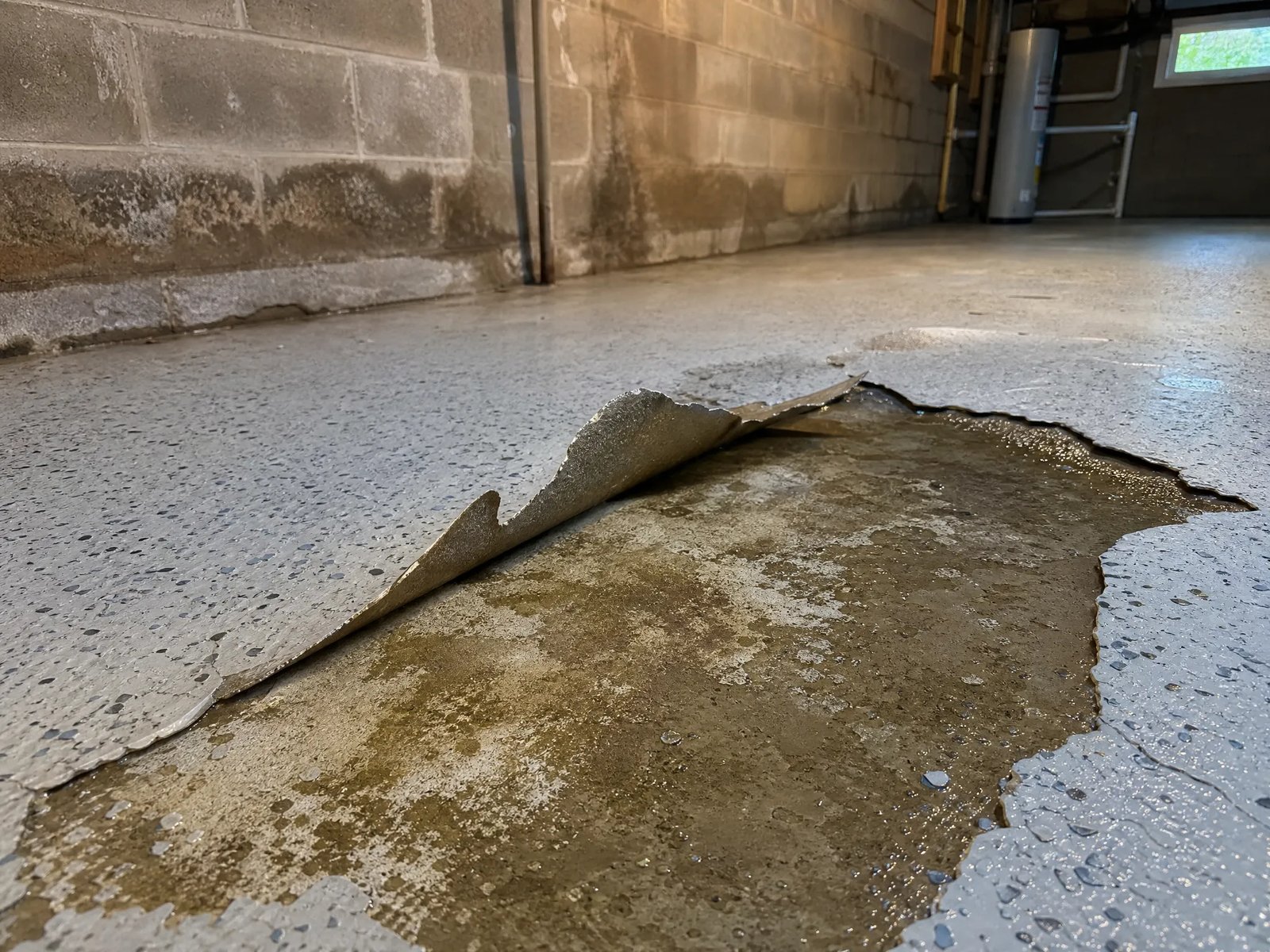
Yes — moisture can cause epoxy floor failure, and it’s one of the most common reasons a coating peels, blisters or turns cloudy. The usual culprit is water vapor rising through a concrete slab. Most coating makers want the slab below a set moisture level before you coat, and the exact number sits in their own written instructions. Here’s what to check, how to test it, and when to walk away.
What moisture does under an epoxy coat

Moisture in a concrete slab isn’t rain sitting on top. It’s water vapor moving up from the soil below, through the slab, and toward the air. Concrete is porous, so this happens in almost every ground-level floor.
Epoxy is a thin, hard, glue-like layer. It sticks tight and doesn’t breathe. When vapor rises and hits that sealed layer, it has nowhere to go. Pressure builds under the film.
That pressure has to escape somewhere. It pushes the epoxy up, and you get bubbles, peeling, or a white cloudy look called blushing. Sometimes the bond fails across a whole room.
The one misconception people bring here is thinking a dry-looking floor is a dry floor. The only way to know is to test it.
How to test and prepare a slab
Testing and prep take real time, and skipping them is where most failures start. Work through this in order.
- Wait for the slab to cure. New concrete needs time before coating. Many makers ask for 28 days minimum, but check your product’s data sheet — some ask longer.
- Pick the test. The in-situ relative humidity test (ASTM F2170) measures humidity inside the slab. The RH test is the more reliable one for most floors.
- Run the test right. One test per 1,000 sq ft is a common starting point — your product sheet may ask for more.
- Compare to the limit. Your coating’s data sheet states the maximum it allows. Don’t guess this number; read it off the sheet for your exact product.
- Fix the surface. Grind or shot-blast to open the concrete’s pores. Acid etching is weaker and often leaves a smooth, sealed surface.
- Fill cracks and pits. Use an epoxy crack filler, not plain cement patch.
- Apply a moisture barrier if needed. A primer made for high-moisture slabs can block vapor. Use only the one your coating maker approves.
- Coat in the right conditions. Confirm on the label.
The one judgement call that decides everything: if the test reads above your product’s limit and you can’t add a proper barrier, don’t coat. No primer trick or extra coat fixes a wet slab.
Numbers and settings at a glance
The figures below are typical starting points, not rules for every product. Your coating’s own data sheet always wins.
| Situation | What to use | How long | What to watch for |
|---|---|---|---|
| New concrete slab | Wait, then test | 28 days cure minimum | Product sheets may ask longer |
| Reading the result | Compare to data sheet limit | — | Every product sets its own max |
| Surface prep | Grind or shot-blast | Until pores open | Etching often leaves it too smooth |
| High reading, no barrier | Moisture-barrier primer | Per maker’s instructions | Only use an approved primer |
| Application climate | 60–85°F, under ~75% humidity | Per label | Cold or damp slows the cure |
What separates a good coat from a bad one
Experienced installers test before they buy anything. They drill, they wait the full 24 hours, and they write the numbers down. If the reading is close to the limit, they don’t gamble — they add a barrier or they pick a different floor.
They also prep harder than beginners expect. Grinding until the surface feels like rough sandpaper, not smooth, is normal. A floor that feels slick under your hand won’t hold epoxy.
Order of work
Prep comes first, then cracks, then primer, then the body coat. Rushing the order — coating over dust or skipping the crack fill — shows up weeks later as peeling edges and hollow spots. Vacuum the whole floor after grinding and wipe it down before you mix anything.
What to leave alone
Once the epoxy is down, hands off. Don’t walk on it early, don’t add a second coat before the maker’s recoat window, and don’t try to fix a small bubble by pressing it. A bubble means vapor is pushing through, and pressing it just spreads the problem. Let it cure fully, then call the maker’s tech line with your test numbers.
Common problems and quick fixes

| What you notice | What it usually means | What to do first |
|---|---|---|
| Bubbles or blisters | Vapor pushing up under the film | Stop, test the slab, check the reading |
| White cloudy patches | Moisture reacting during cure | Confirm slab and air temperature and humidity |
| Peeling at edges | Poor prep or water at the edge | Grind back, re-test, re-prep that area |
| Coating lifts in sheets | Vapor pressure over a large area | Test the whole slab; a barrier may be needed |
| Soft, tacky finish | Wrong mix ratio or cold, damp air | Check mix and room conditions before recoating |
If a fix needs you to grind, re-test, or add a barrier, that’s normal repair work. But if the slab keeps reading high after a barrier, stop and call a flooring contractor who handles moisture problems for a living.
The rules and standards that apply
The test methods here come from ASTM International, which publishes both the calcium chloride test (ASTM F1869) and the in-situ relative humidity test (ASTM F2170). Those are the two standards most coating makers name in their own instructions.
Your real limit comes from the product, not a general rule. Every epoxy maker prints its own maximum moisture number on the technical data sheet, and those numbers differ between products. Read the sheet for the exact can you bought.
For commercial or structural floors, a licensed flooring contractor or a concrete specialist should handle the testing and any moisture barrier. Slab moisture ties into waterproofing and structural work that’s outside a normal DIY job.
The American Concrete Institute publishes guidance on slab moisture and floor covering if you want to go deeper.
Keeping the floor sound afterwards
Once the epoxy is cured, keep water away from the edges. Most failures start where the coating meets a wall, a drain, or a garage door — places where water sits. Wipe up standing water instead of letting it soak in.
Watch for the early signs: a hollow sound when you tap the floor, small bubbles, or a white haze. Any of those means moisture is moving again, and catching it early saves the whole floor. Re-test the slab if you see them.
For cleaning, use a pH-neutral cleaner and a damp mop. Harsh chemicals and a soaking wet mop push water into seams over time. A coated floor should stay sound for years if the slab was dry when you started — but the slab’s moisture level is the thing that decides that, and only a test tells you where yours sits.
When epoxy isn’t the right choice

Epoxy is the wrong pick if your slab tests high and you can’t add a barrier. In that case, a breathable coating or a moisture-tolerant product is a better fit — check what your maker offers for damp slabs.
It’s also wrong for a floor that stays wet, like an outdoor slab with poor drainage. Fix the drainage first, or use a different surface.
And skip epoxy if the slab is brand new and still curing. Wait out the full cure time, then test. Coating early traps moisture and wastes the whole job.
Frequently asked questions
Can moisture cause epoxy floor failure?
Yes. Rising vapor from the slab gets trapped under the sealed epoxy, builds pressure, and pushes the coating up. That shows as bubbles, peeling, or a cloudy white haze. It’s one of the most common reasons epoxy floors fail, and a slab moisture test is the only way to catch it before you coat.
How long should I wait before coating new concrete?
At least 28 days is the common minimum, but check your product’s data sheet — some makers ask for longer. The safe move is to wait the full cure, then run a moisture test. If the reading is under your product’s limit, you’re clear to coat.
Is it safe to epoxy over a damp slab?
No, not without a moisture barrier made for that job. Coating a damp slab traps vapor and the floor will fail. Test first, and if the reading is high, use an approved moisture-barrier primer or pick a different flooring option.
Why did my epoxy floor turn white and cloudy?
It happens when the slab or the air is too damp or too cold while the epoxy sets. Check your room conditions against the label, and test the slab before you recoat.
What happens if I coat over a wet slab anyway?
The epoxy will likely bubble, peel, or lift within weeks. You’ll then have to grind the whole floor back down, fix the moisture problem, and start again. That’s far more work and cost than testing the slab up front.
How often should I check a coated floor for moisture problems?
There’s no fixed schedule — watch for signs instead. Tap for hollow spots, look for bubbles or a white haze, and check edges and drains after heavy rain. If you see any of those, re-test the slab right away.
Can a primer fix a high moisture reading?
Only a primer made and approved for moisture blocking, and only if the reading isn’t too far over the limit. A standard primer won’t stop vapor. If the reading is well above your product’s max, no primer fixes it — you need a different floor.
Conclusion
Moisture is the quiet reason epoxy floors fail, and it hides in a slab that looks perfectly dry. Test before you coat, compare the number to your product’s own limit, and add a barrier when the reading is close. That one step — done properly, with the right test and the full wait time — is what keeps a floor stuck down for years instead of peeling up in months.
