

You spent good money or a grueling weekend putting down a gorgeous, glossy epoxy garage floor. It looks like a high-end auto showroom. But fast-forward a few months: track in some muddy tire marks, spill a little engine oil, and let a layer of gritty winter road salt settle over it. Suddenly, that showroom shine looks tired, hazy, and dull.
So, how do you clean an epoxy coated garage floor without scratching the finish or leaving an ugly film behind?
The short answer: Vacuum up the abrasive grit, mop with a mixture of hot water and a few ounces of clear ammonia (or an epoxy-safe degreaser like Simple Green), and squeegee it dry.
Whatever you do, keep the household dish soap and vinegar in the kitchen! Using the wrong cleaners will ruin your resin floor faster than a set of hot tires. In this guide, you will learn the exact recipe to keep your epoxy looking brand-new for decades.
The Chemistry of Clean: Why Popular Cleaners Ruin Epoxy
Why can’t you just use whatever soap is sitting under the kitchen sink? It comes down to how epoxy handles chemical residues.
Epoxy is incredibly tough, but its smooth, non-porous surface is sensitive to certain chemicals. If you use the wrong cleaner, you will experience one of two floor-killing problems:
The Soap Film Blur:
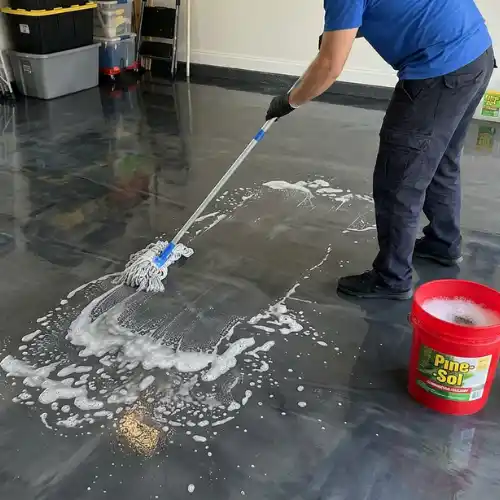
Standard dish soaps (like Dawn) and commercial floor cleaners (like Pine-Sol) leave behind a microscopic layer of soap scum. On bare concrete, you don’t notice it. On glossy epoxy, it builds up over time, trapping dirt, creating a slippery hazard when wet, and completely killing the floor’s reflection.
The Acid Etch Threat:
Many homeowners think vinegar or citrus cleaners are safe because they are “natural.” They aren’t. Vinegar contains acetic acid. Over time, that acid slowly eats away at the glossy topcoat of your epoxy, permanently dulling the finish.
Cleaner Showdown: Safe vs. Destructive
| Cleaner Type | What It Does to Epoxy | The Verdict |
| Clear Ammonia + Hot Water | Cuts grease cleanly and evaporates 100% without leaving a film. | The Gold Standard |
| Simple Green / Simple Degreasers | Safely lifts heavy oil and tire marks without damaging the resin. | Great for Spot Cleaning |
| Dish Soap / Pine-Sol | Leaves a sticky, dull microscopic layer of soap scum. | Avoid Completely |
| Vinegar / Citrus Cleaners | Slowly etches and breaks down the glossy topcoat over time. | Banned from the Garage |
Step-by-Step: Weekly Garage Floor Cleaning Routine
Ready to make that floor pop again? Follow this strict recipe once a week or every two weeks to prevent abrasive dirt from scratching your clear coat.
1. Clear the Grit:5 mins.
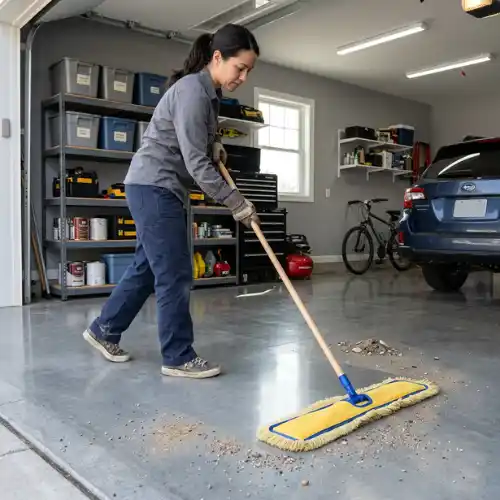
Use a soft-bristled dust mop or a shop-vac with a brush attachment to remove all loose dirt, sand, and pebbles. If you leave grit on the floor and start mopping, you are essentially rubbing sandpaper all over your shiny floor! Avoid industrial string mops—they drop lint and leave streaks.
2. Mix Your Magic Formula: 2 mins.
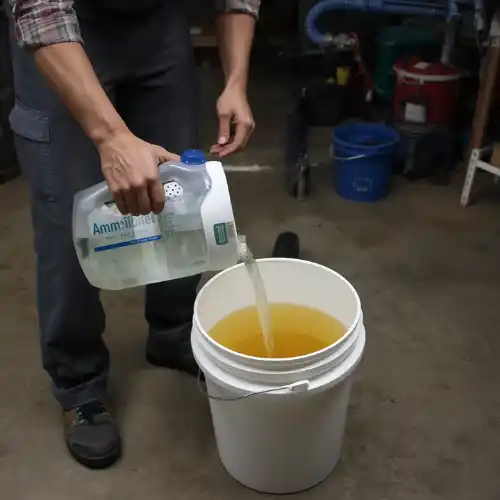
Fill a five-gallon bucket with warm-to-hot water. Add 2 to 3 ounces of clear ammonia per gallon of water. It doesn’t sound like much, but a little goes a long way.
3. Mop in Sections: 10 mins.
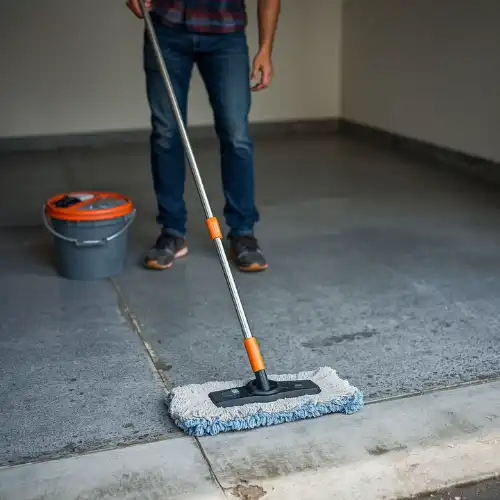
Dip a microfiber or foam sponge mop into the solution, wring it out so it is damp (not dripping wet), and clean the floor in sections. Rinse your mop frequently in the bucket to avoid spreading dirty water into the contraction joints or saw cuts.
4. The Squeegee Finish: 3 mins.
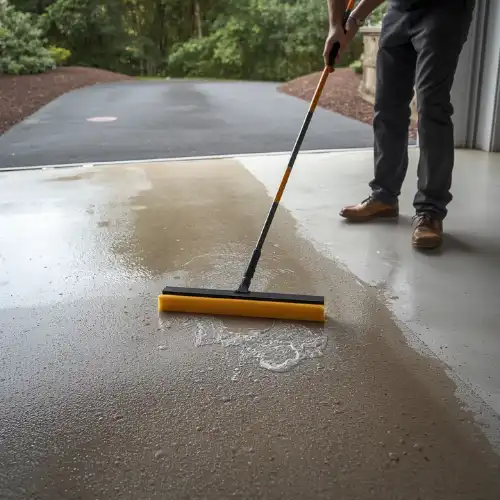
Don’t just let the water air-dry, or you might end up with water spots from minerals in your tap water. Pull a foam rubber floor squeegee across the floor toward the driveway to leave a flawlessly clean, streak-free surface.
Related Article: Fish Eyes in Epoxy: Why They Happen and How to Fix Them
How to Attack Stubborn Stains & Tire Marks
Sometimes routine mopping isn’t enough. When life happens in your garage, here is how to troubleshoot the tough stuff without stripping your protective coating:
1. Removing Sticky Hot Tire Marks
When hot rubber tires park on epoxy, they undergo a process called plasticizer migration, basically tattooing a dark rubber mark onto the floor. Normal mopping won’t touch this. Spray the area with a concentrated degreaser like Simple Green, let it sit for 5 minutes to break down the grime, and scrub it gently with a soft-bristled nylon deck brush. Wipe it clean with a microfiber towel.
2. Eliminating Rust Stains
If an old metal tool chest or a rusty car part left a brown ring on your floor, do not scrub it with steel wool—you will scratch the epoxy completely. Instead, apply a gentle rust remover (like CLR) mixed 1:1 with water directly to the stain. Scrub lightly with a soft kitchen sponge, rinse thoroughly with fresh water within 2 minutes, and dry.
3. Handling Winter Road Salt & Sludge
If you live in a snowy climate, road salt and brine will leave a white, crusty film on your floor. Tackle this seasonally by rinsing the floor with a water hose first to dissolve the salt, then use a double-dosage ammonia mix (5 ounces per gallon) to completely lift the film before squeegeeing it out the door.
Pro-Tip on Scrubbing: Never use scouring pads, brass brushes, wire bristle brooms, or Magic Erasers on an epoxy floor. Epoxy is highly scratch-resistant, but metal or stiff abrasive micro-scrubbers will leave hazy swirl marks that are impossible to buff out by hand.
FAQs About Cleaning Epoxy Garage Floors
Can I use Dawn dish soap on epoxy floors?
You can, but you shouldn’t make it a habit. While Dawn is great at cutting grease, it leaves behind a microscopic, sticky soap film on non-porous surfaces. Over time, this film builds up, traps dirt, and completely kills your floor’s beautiful gloss. Stick to clear ammonia and hot water for routine mopping to keep that showroom shine.
What happens if I use vinegar to clean my epoxy floor?
Vinegar contains acetic acid, which is highly destructive to resinous coatings. While it seems like a safe, natural cleaner, that mild acid will slowly etch and eat away at the glossy clear coat over time. Once the gloss is chemically dulled by acid, you cannot wash it away—the finish is permanently damaged.
Can I use a pressure washer on an epoxy floor?
Yes, but you need to be careful with the pressure setting. Epoxy forms an incredibly strong bond with concrete, but a high-psi pressure washer held too close to the surface can chip the coating, especially if there is an existing scratch or nick. Keep the pressure under 2,000 PSI, use a wide 45-degree fan tip, and keep the nozzle moving at least 18 inches off the ground.
How do I clean a sticky chemical spill or engine oil?
For oil or fluid spills, wipe them up right away with paper towels or shop rags. For fresh spills, you can even toss down kitty litter or sawdust to absorb the bulk of it. Once the puddle is gone, spritz the spot with Simple Green or Windex with ammonia to get the spot squeaky clean and streak-free.
Conclusion: Maintain the Showroom Shine
Cleaning epoxy garage floor surfaces successfully doesn’t require expensive, specialized chemicals—it just requires avoiding the common traps that ruin the clear coat. By keeping abrasive grit vacuumed up, using ammonia to avoid soap scum, and finishing with a quality foam squeegee, your garage floor will stay shiny, durable, and clean for decades.
Are you dealing with a stubborn stain that just won’t budge? Get your tools ready, stick to the guide, and restore your floor’s brilliant shine today!
To see these steps put into real-world practice, check out this excellent Epoxy Garage Floor Cleaning Guide which visually demonstrates how to use hot water, Simple Green, a deck brush, and a squeegee to safely remove dirt without scratching your finish.

3 responses to “How to Clean Epoxy Coated Garage Floors?”
[…] How to Clean Epoxy Coated Garage Floors? […]
[…] Related Article: How to Clean Epoxy Coated Garage Floors? […]
[…] How to Clean Epoxy Coated Garage Floors? […]