

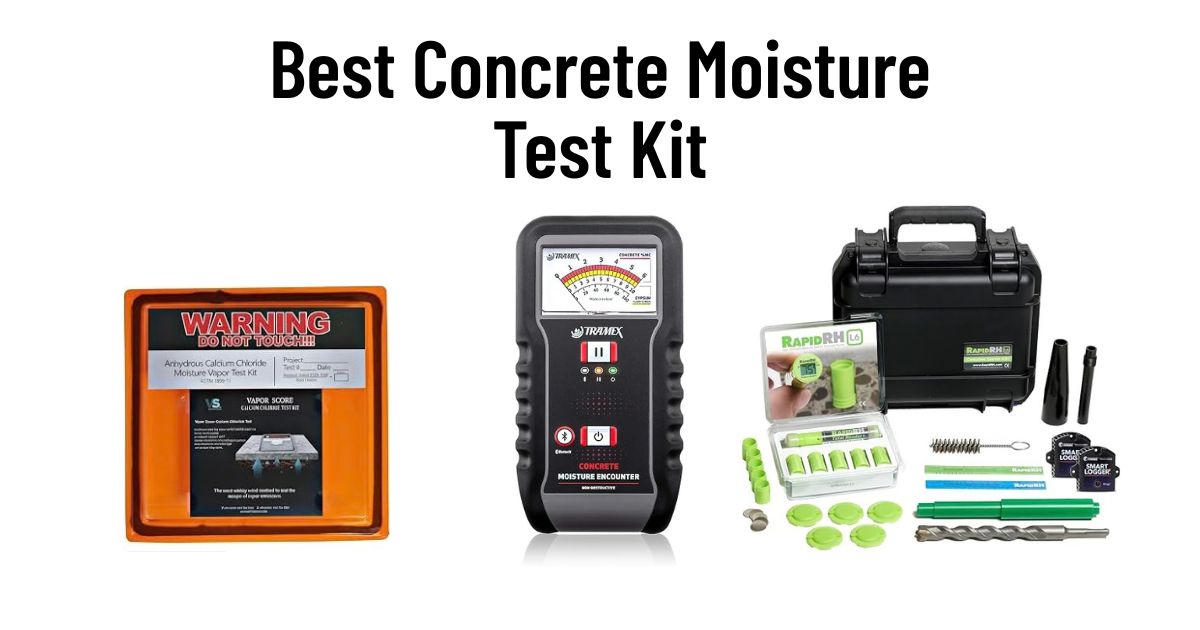
You were about to lay down new flooring when you realized the slab might be too wet. That worry is exactly what sends someone searching for the best concrete moisture test kit. A damp slab can ruin hardwood, lift tile, or blister epoxy in a matter of months. You don’t want to pull up your work later because you skipped this step.
Picking one isn’t simple, because these kits use two very different methods that don’t always agree. Some measure vapor leaving the surface over days, while others read conditions deep inside the slab in seconds. You’ll also have to weigh whether you need a tool that leaves no mark or one that meets a specific building code. This page lays out what each option actually includes and who it serves, so you can pick the right one without guessing.
As an Amazon Associate, we earn from qualifying purchases. This post contains affiliate links – if you buy through them, we may earn a commission at no extra cost to you.
| # | Image | Product | |
|---|---|---|---|
| 1 |  | Vapor Score Concrete KitBest Calcium Chloride Kit | Check Price |
| 2 |  | Wagner Rapid RH L6Best In-Situ RH System | Check Price |
| 3 | 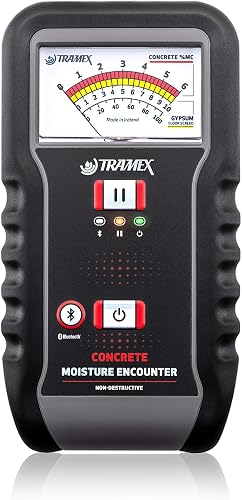 | Tramex CME5Best Non-Destructive Meter | Check Price |
| 4 |  | Gundlach Moisture pH KitBest With pH Test | Check Price |
| 5 |  | Rapid RH Starter KitBest Professional Starter Kit | Check Price |
| 6 |  | LASELION MS03Best Dual-Mode Meter | Check Price |
| 7 |  | CME-822 Concrete MeterBest Digital Slab Meter | Check Price |
| 8 |  | Wagner C555Best Pinless Concrete Meter | Check Price |
| 9 |  | PCE Instruments PCE-PMI 2Best Full-Range Meter | Check Price |
| 10 |  | Lignomat BWBest Dual-Depth Scanner | Check Price |
1. Vapor Score Concrete Moisture Test Kit
Right for: DIYers needing standard calcium chloride tests before laying home flooring.
This three-pack gives you everything for ASTM F1869 testing, including calcium chloride components, distilled water, and pH strips. The listing notes it works on sealed concrete when prep rules are followed. You leave the test in place for 60 to 72 hours to get a reading. Step-by-step instructions are included to guide you through the wait.
On an ordinary day, you’d clean the slab, set the dish, and wait nearly three days before you know anything. That means you can’t rush the job if the room needs to stay clear. The included pH strips let you check alkalinity at the same time, which saves a separate trip to the store. It’s not for contractors who need to test multiple sites in a single afternoon, since the waiting period ties up your schedule.
What works:
- Includes distilled water and pH strips together
- Three full tests provided in one package
- Meets ASTM F1869 standards for emissions testing
- Works on sealed concrete with proper preparation
Where it gives ground:
- Requires 60 to 72 hours for results
- Ties up floor space during the testing window
Skip it if: you need instant readings to keep a fast job moving.
2. Wagner Meters Rapid RH® L6 Smart Sensors
Right for: Contractors already owning the Total Reader needing sensor refills.
This five-pack holds factory-calibrated Smart Sensors designed for ASTM F2170 in-situ relative humidity testing. Each refill comes with extensions, protective caps with rubber plugs, stainless steel covers, a calibration certificate, and a floor map. The sensors are single-use, meaning there’s no recalibration required between jobs. You pair them with the DataMaster L6 app via Bluetooth to generate reports.
Because these measure inside the slab rather than just at the surface, they show what moisture will do weeks after the floor goes down. You drill the holes, drop the sensors in, wait for equilibration, and scan them in seconds with your reader. Leaving them in place lets you check back later without drilling again. This pack won’t work for someone buying their first setup, since the Total Reader is sold separately and you can’t take a reading without it.
What works:
- Factory-calibrated sensors eliminate recalibration steps
- Bluetooth reporting simplifies documentation compliance
- Sensors remain in place for future follow-up checks
- Measures internal slab moisture per ASTM F2170
Where it gives ground:
- Total Reader is required but sold separately
- Single-use design means sensors can’t be reused
Skip it if: you don’t already own the L6 Total Reader.
3. Tramex Concrete Moisture Encounter CME5
Right for: Inspectors mapping moisture non-destructively across large commercial floors.
The CME5 is a pinless analog meter built for ASTM F2659 surface moisture evaluation on concrete slabs and screeds. It offers dual-depth measurement, reaching 0.4″ (9 mm) shallow and 1.25″ (30 mm) deep to compare surface and core levels. The device is pre-calibrated for various material densities like wood, drywall, plaster, and masonry. Bluetooth connectivity allows you to geotag and time-stamp reports using their app.
Being able to switch between shallow and deep penetration means you can spot whether moisture is trapped below a coating or just sitting on top. You simply press it against the floor and read the dial, leaving zero marks behind. The analog display keeps things straightforward without menus to navigate. It also measures wood moisture from 5-30% using adjustment tables for wood type density.
What works:
- Dual depth reaches 0.4″ and 1.25″ into materials
- Pinless scanning leaves no marks on surfaces
- Bluetooth app enables geotagged visual mapping
- Pre-calibrated for multiple building material densities
Where it gives ground:
- Primarily designed for concrete over other materials
Skip it if: you only need a basic digital number on screen.
4. Gundlach Concrete Moisture and pH Test Kit (923-1)
Right for: Installers needing one simple calcium chloride and pH test.
This kit provides a single calcium chloride test alongside pH test papers. The listing describes it as widely recommended by floor covering product manufacturers. It focuses purely on the basics needed to check a slab before installation. There are no extra sensors, apps, or reusable tools included in the box.
For a quick, one-off job, having the pH papers bundled in means you handle two common flooring requirements at once. You open it, run the test, and you’re done without managing leftover supplies. It suits someone doing a single room who doesn’t plan to test again soon. If you’re tackling a whole house or working professionally, a single-test kit forces you to order more immediately.
What works:
- Bundles pH test papers with calcium chloride test
- Recommended by floor covering product manufacturers
- Simple single-kit format avoids unused extras
Where it gives ground:
- Only provides enough materials for one test
- No reusable components for future projects
Skip it if: your project spans multiple rooms or zones.
5. Rapid RH L6 Concrete Moisture Test Starter Kit+ (Fahrenheit)
Right for: Professionals setting up complete ASTM F2170 testing from scratch.
This starter bundle includes five L6 Smart Sensors and the Fahrenheit Total Reader with Bluetooth. It also packs two Smart Logger V2 ambient recorders, a ¾” SDS masonry drill bit, an insertion tool, a wire cleaning brush, and a vacuum attachment. Everything fits into an included carrying case alongside extensions, protective caps, stainless steel covers, a calibration certificate, a floor map, and a battery.
Having the drill bit, vacuum, and loggers in one case means you don’t waste time hunting for compatible accessories on site. You can drill the holes, clean them out, log the room’s temperature, and take your readings all from the same box. The Bluetooth reader pairs with the app to organize those readings into professional reports instantly. A homeowner fixing one bathroom floor doesn’t need ambient loggers or five sensors, making this setup excessive for casual use.
What works:
- Includes Total Reader, sensors, and drilling tools
- Ambient loggers track room temperature and humidity
- Carrying case organizes every component for transport
- Covers entire ASTM F2170 workflow out of box
Where it gives ground:
- Contains far more than a single small job requires
- Heavier kit to carry for simple residential tasks
Skip it if: your project is limited to a single small space.
6. LASELION 2-in-1 Pin & Pinless Moisture Meter MS03
Right for: Homeowners who want a single handheld device capable of scanning several different building materials.
The MS03 offers both pin and pinless measurement modes for detecting moisture across wood, drywall, plaster, concrete, and cardboard. It reads 0-75% in wood and 0-25% in building materials, stating an accuracy of ±4%RH. Features include a built-in flashlight, ambient temperature display, manual calibration for pinless mode, and an auto power-off after 2 minutes. The LCD screen has a hold function to lock in your reading.
Switching between pins and pinless scanning lets you poke into thick lumber without scratching finished furniture or antique wood. The built-in flashlight helps when you’re working in dark basements or under cabinets where overhead lights don’t reach. Auto power-off saves the battery if you set it down and forget it mid-job. It’s not built for strict ASTM concrete certification, so inspectors needing official compliance documents should look elsewhere.
What works:
- Pin and pinless modes cover many different materials
- Built-in flashlight aids work in dark spaces
- The device shuts itself down automatically to preserve battery life when left idle.
- Manual calibration supports pinless mode adjustments
Where it gives ground:
- Not listed for formal ASTM concrete compliance testing
- Accuracy stated at ±4%RH may vary by material
Skip it if: you require certified ASTM slab documentation.
7. Concrete Moisture Meter CME-822
Right for: Restoration pros scanning large slabs quickly for hidden wet spots.
Designed specifically for concrete floors, slabs, and walls, the CME-822 uses a non-destructive electromagnetic sensor to scan without drilling. It provides a wide 0-70% measuring range with instant digital readings and auto temperature compensation. Adjustable CD codes optimize measurements for concrete, mortar, gypsum, and a reference mode. An audible buzzer and warning light alert you when moisture exceeds preset thresholds, alongside hold and max value functions.
Scanning a large garage floor becomes much faster when the alarm buzzes at wet spots instead of you staring at numbers constantly. The max value function captures the highest reading during your sweep, so you know exactly where the worst moisture sits. Auto temperature compensation keeps those readings stable even if the room gets colder near exterior walls. Because it relies on CD codes rather than automatic detection, you must remember to select the right material setting before every scan.
What works:
- Electromagnetic sensor scans without damaging surfaces
- Audible and visual alerts flag high moisture zones
- Max value function captures peak readings automatically
- Auto temperature compensation stabilizes changing environments
Where it gives ground:
- Requires manual selection of correct CD material codes
Skip it if: you frequently switch between wood and concrete.
8. Wagner Meters C555 Pinless Concrete Moisture Meter
Right for: Installers pinpointing hotspots before placing in-situ RH sensors.
The C555 delivers fast, non-destructive preliminary moisture measurements on smooth, firm concrete to help locate problem areas. It uses a relative measurement mode scaled from 1 to 100 and includes a built-in alarm adjustable from 0.0% to 6.9%. Beyond concrete, it measures brick and gypsum, monitors ambient temperature and humidity, and calculates dew point. A backlit screen ensures readability in low-light conditions, and it ships with a standard calibrator.
Using this to find the wettest part of a slab tells you exactly where to drill for deeper testing, saving you from guessing. The dew point calculation helps you see if condensation might form on the surface later, which matters before applying coatings. Monitoring ambient conditions simultaneously means you don’t need a separate thermometer in your pocket. The listing explicitly warns it only measures concrete, brick, and gypsum, so anyone needing to test wood or drywall will get inaccurate readings.
What works:
- Locates hotspots to guide precise sensor placement
- Calculates dew point to identify condensation risks
- Monitors ambient temperature and humidity simultaneously
- Includes standard calibrator for verifying accuracy
Where it gives ground:
- Strictly limited to concrete, brick, and gypsum
- Provides relative scale rather than absolute percentage
Skip it if: you need to measure wood or other materials.
9. PCE Instruments PCE-PMI 2 Concrete Moisture Meter
Right for: Building inspectors evaluating diverse materials non-destructively.
This meter uses an electrical resistance measuring principle to provide non-destructive, non-invasive testing. It covers a full 0–100% moisture range and penetrates up to 50 mm / 1.96 inches into the material. The listing states it works for concrete, cement, cork, wood, plaster, rubber, and more. It features an LCD display, a hold function, and an alarm that triggers when exceeding threshold levels.
A penetration depth of 1.96 inches reaches well past the surface layer, giving you a clearer picture of what’s happening inside thick pours. The 0-100% scale handles almost any building material you encounter on a mixed-use inspection site without swapping tools. Setting the alarm threshold lets you sweep a room quickly while the device flags trouble spots for you.
What works:
- Penetrates up to 1.96 inches into tested materials
- Full 0-100% scale covers wide moisture variations
- Works across concrete, wood, plaster, rubber, cork
- Alarm function flags readings above set thresholds
Where it gives ground:
Skip it if: you need strict ASTM-compliant certification numbers.
10. Lignomat BW Dual Depth Moisture Meter Concrete Moisture
Right for: Woodworkers and inspectors needing dual-depth readings on varied materials.
The BW provides precise moisture readings at 1/4″ and 3/4″ depths using pinless technology that doesn’t damage surfaces. It combines moisture detection with a relative humidity thermometer and in-situ concrete humidity testing. The device includes specialized preset calibrations for domestic and tropical woods, OSB, engineered floors, and bamboo. Its rugged construction includes reference scales for additional materials like concrete, textiles, and stone.
Checking both 1/4″ and 3/4″ depths reveals if a floor is drying evenly or trapping moisture underneath. Having dedicated calibrations for bamboo and engineered floors means you aren’t forcing a generic setting onto sensitive materials. The built-in relative humidity thermometer adds environmental context to your surface readings without carrying extra gear. While it lists reference scales for concrete, professionals relying solely on strict ASTM concrete protocols might prefer a system purpose-built entirely around that single standard.
What works:
- Reads accurately at 1/4″ and 3/4″ depths
- Preset calibrations tailored for specific wood types
- Includes relative humidity thermometer functionality
- Rugged build withstands daily field inspection use
Where it gives ground:
Skip it if: you exclusively test concrete for commercial certification.
How to Think Before You Choose
Surface Scans Versus Internal Readings
Moisture meters fall into two main camps: those that read the surface and those that measure inside the slab. Surface scanners use electromagnetic signals to detect dampness near the top without leaving a mark. Internal systems require drilling holes to place sensors at a specific depth within the concrete. The trade-off is speed versus long-term accuracy.
Surface scans give you an answer instantly, letting you map a whole room in minutes. However, a slab can feel dry on top while holding significant moisture deep down, especially if a curing compound was applied. Internal sensors take longer to equilibrate but show what the floor will actually do to your adhesive months later. Most people laying permanent flooring should lean toward internal testing to prevent failures.
Before deciding, measure your slab’s total thickness. Knowing this measurement tells you whether you even have the physical depth required for certain probes, or if a surface scan is your only practical option.
Waiting Days Or Getting Instant Results
Some testing methods demand patience, while others give you numbers right away. Calcium chloride kits require sealing a dish to the floor and leaving it undisturbed for 60 to 72 hours. Electronic meters provide a reading the moment you turn them on and press them to the surface. The choice depends entirely on your project timeline.
If you’re renovating your own home over several weekends, a multi-day wait rarely causes problems. For contractors scheduling multiple trades back-to-back, tying up a room for three days disrupts the entire build sequence. Electronic options solve that delay but often serve as preliminary checks rather than final proof. Lean toward electronic tools for planning, and reserve timed tests for final verification if required.
Check your flooring manufacturer’s installation guidelines before choosing. Many warranties explicitly state which testing method they accept. If your warranty demands a 72-hour test result, buying an instant-read meter won’t satisfy the paperwork requirement, regardless of how convenient it feels on the day.
Single-Use Components Or Reusable Tools
Certain testing systems rely on disposable sensors that go into the slab and stay there. Other devices are solid blocks you carry from job to job for years. Disposable sensors guarantee factory-fresh calibration every single time you use them. Reusable tools require you to maintain, clean, and occasionally verify their accuracy yourself.
Single-use sensors remove the risk of a drifted calibration ruining your data. You open the package, insert it, and trust the certificate inside. The trade-off is that you must keep buying refills to continue working. Reusable meters let you scan another room without replacing components.
Count how many rooms or job sites you plan to test over the next year. If your scope is limited to a single residential remodel, a single-use kit or basic meter makes sense. If you inspect dozens of slabs monthly, tracking your sensor inventory becomes a daily task, making a durable, reusable tool the logical path forward.
Who Should Skip These Altogether
Not every moisture problem requires a dedicated concrete testing kit.
- If you only need to check a small patch of drywall or a piece of furniture, a general-purpose wood meter serves you better than a concrete-specific tool.
- If your flooring manufacturer provides a specific proprietary testing service or requires their authorized inspector to validate the warranty, buying your own kit won’t replace their visit.
- If the slab is actively flooded or visibly pooling water, no test kit will tell you anything you can’t already see; you need extraction equipment and drying fans first.
- If you’re testing a rental property once just to satisfy curiosity and never plan to install flooring, hiring an inspector for a single report saves you from storing unused tools.
The Vapor Score Concrete Kit remains the most practical choice for most buyers needing reliable ASTM F1869 compliance. For contractors starting fresh who need to drill, log, and report, the Rapid RH Starter Kit handles the harder professional workflow completely. Measure your slab thickness today to confirm which depth standard applies to your space before ordering.
Frequently Asked Questions
What does a concrete moisture test actually measure?
A concrete moisture test measures vapor emissions or internal relative humidity to prevent flooring failure. Calcium chloride kits follow ASTM F1869, while in-situ sensors like the Wagner Rapid RH L6 follow ASTM F2170. Always match the testing method to your floor covering manufacturer’s specific warranty standard.
What maintenance do these tools require after purchase?
Maintenance depends on whether the tool uses reusable electronics or disposable components. Single-use sensors like those in the Wagner Rapid RH L6 require zero maintenance, while electronic meters such as the Wagner C555 need periodic calibration checks. Neglecting calibration leads to false confidence in readings.
What usually fails first on a moisture testing device?
On pin-style meters, metal probes bend or corrode first when pushed into dense concrete repeatedly. Non-destructive scanners like the CME-822 suffer scratches that alter readings, and Bluetooth systems such as the Tramex CME5 experience software drops. Check pins, plates, and seals before every job to extend tool life.
Is a basic surface meter enough for installing hardwood?
A basic surface meter is rarely sufficient as the sole test for permanent hardwood installations. Manufacturers typically require ASTM F1869 calcium chloride results or ASTM F2170 in-situ relative humidity readings to honor warranties. Using only a surface meter risks installing expensive wood over deep moisture and voids the warranty.
What should I confirm about my slab before ordering a kit?
Before ordering, confirm whether your concrete slab is sealed, painted, or covered in old adhesive residue. Tests like the Vapor Score Concrete Kit work on sealed concrete only when preparation complies with ASTM F1869 requirements. Verify exactly which testing standard your flooring manufacturer requires for warranty validation.
Conclusion
Don’t let a damp slab surprise you after the work is done. Grab your gear, run a quick check this weekend, and you’ll feel confident laying down that new floor. It’s a small effort that saves you from a big headache later on.


