


Affiliate disclosure: we take part in the Amazon Associates programme, so buying a product through a link here may earn us a commission. The price you pay stays the same.
Concrete Patch for Spalling
A good concrete patch fills spalled spots, holds its shape as it cures, and blends with the slab around it.
A chunk of concrete pops off the edge of your front step, and now there’s a jagged hole right where everyone walks. You cover it with a board and tell yourself you’ll deal with it this weekend, before someone catches a toe on it. Then the weekend comes, and you’re standing in the aisle staring at a wall of gray buckets, not sure which one actually works.
That’s what best concrete patch for spalling is about. Spalling happens when water gets into the concrete, freezes, and pushes the surface off — leaving pits, craters, and broken edges. A patch fills that damage back in, stops water from getting in again, and makes the surface safe to walk on. Some patches are ready-mixed pastes you spread with a trowel. Others are powders you mix, or liquids you pour into cracks. The right one depends on how deep the damage goes and where it is. Here are the picks that cover those cases.
1. DAP Ready-Mixed Concrete Patch

Best for: Someone fixing a small spalled spot without mixing anything.
This is a ready-mixed gray paste in a 32-ounce container. The listing says it repairs cracks and breaks in interior or exterior concrete and masonry, and that the formula is non-shrinking for lasting repairs. The listing also notes it can be used to repair, spot level, or tuck point.
Because it’s premixed, there’s no bucket, no water, and no measuring — you open it and start spreading. That matters on a small spall where mixing a batch would leave you throwing most of it away. The non-shrinking claim is the one to care about here: a patch that shrinks pulls away from the edges as it dries, and water gets straight back in. One thing the listing is clear on: allow the concrete sealer to dry 24 hours before driving over the patched area. So this suits a walkway, step, or patio edge, not a driveway you need back the same day.
Pros
- Ready to use straight from the container
- Non-shrinking formula per the listing
- Dries gray to blend with existing concrete
- Works inside or outside
- Also handles spot leveling and tuck pointing
Cons
- Listing says to wait 24 hours before driving over it
- Not a structural repair for deep, load-bearing damage
Why this one: Take this if you want the simplest path to a small, shallow spall on a walkway or step — no mixing, no cleanup bucket, no leftover powder. If your damage is deeper than a surface crater, or you need a car back on it fast, one of the powder or liquid picks further down fits better.
2. SIKA Sikacryl Ready-Mix Concrete Repair Patch

Best for: A repair that needs to match a textured concrete surface.
Sika’s entry is a ready-mix gray patch in a one-quart container, and the listing leans hard on one detail: it’s textured. That texture is the point. A smooth patch on a broom-finished sidewalk or a stucco wall reads as a patch from across the street. A textured one blends into the surrounding surface instead. The listing says it fixes cracks and spalls, and that it’s formulated to avoid shrinking or cracking, with good adhesion and high strength for slabs, walls, and walkways.
Cleanup is where this one separates itself. It’s acrylic-based, so once you’re done you clean up with water — no solvents, no special cleaners. The listing also says it follows VOC regulations, and that minimal prep is needed since it comes premixed. You spread it with a putty knife or trowel. Timing from the listing: a few hours to set, then a full day before it has cured through. You can’t treat the surface as normal until the cure is complete, so plan the repair around that wait.
Pros
- Textured finish blends with existing surfaces
- Water cleanup, no special cleaners needed
- Formulated to avoid shrinking or cracking
- Minimal prep, comes premixed
- Follows VOC regulations per the listing
Cons
- About a day for full cure
- Spreads by trowel or putty knife, not a pour
Why this one: This is the pick if the look of the repair matters as much as the repair — a textured walkway, a stucco wall, a visible slab. If you’re filling a narrow crack rather than a spalled area, a pourable filler does that job with less fuss.
3. Red Devil 0644 Concrete Repair Patch

Best for: Patching lighter gray concrete.
Red Devil’s patch is a premixed formula in a one-quart container, made in the USA. The listing says the premixed formula makes repairs easy, and that it repairs cracks and breaks in concrete. Two details stand out. First, it dries a light to medium gray — the listing calls that ideal for lighter shades of concrete. Second, it won’t shrink or crack, which the listing frames as maximum flexibility for a permanent repair.
The color point is worth pausing on. Most patches dry to a mid-gray, and on a pale slab that difference shows. If your concrete is on the light side, this is the one whose listing actually addresses that. It can be used inside or outside, and that it cleans up easily with soap and water. The trade-off is the same one every paste patch carries: you’re spreading it by hand into the damage, so it suits cracks and shallow spalls rather than rebuilding a deep broken corner.
Pros
- Dries light to medium gray for lighter concrete
- Premixed for easy application
- Won’t shrink or crack per the listing
- Interior or exterior use
- Soap and water cleanup
Cons
- Color match is aimed at lighter concrete shades
- Hand-applied, so not for deep rebuilds
Why this one: Choose this if your slab is a pale gray and you want the patch to disappear into it. If your concrete is darker, or the damage is a wide shallow crater rather than a crack, another pick here will blend better.
4. DAP Concrete and Mortar Repair
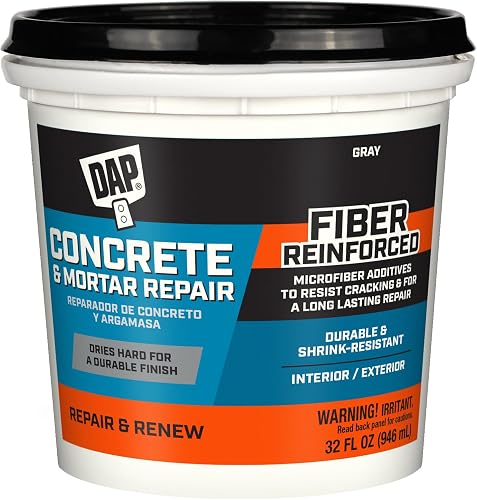
Best for: Repairing mortar joints and masonry alongside the concrete.
This is a 32-ounce gray patch built for cracks and breaks in cement and masonry surfaces. The listing says the formula won’t sink or shrink, and that you should apply it in temperatures above 40 degrees Fahrenheit. The cure schedule is the most specific of any pick here: full cure after 48 hours for a 1/4-inch depth repair, and you add 48 hours for each additional 1/4 inch of depth. For repairs greater than 1/2 inch thick, the listing points you to the product instructions.
That depth math is the honest heart of this product. A shallow spall cures in a couple of days. A deep crater takes considerably longer, and you can’t rush it. The listing also gives you paint windows: sealer sets in 3 to 5 hours, latex paint goes on in 2 to 4 hours, oil-based paint after 24 hours. It’s ideal for spot leveling, filling holes, cracks, dents, and defects on interior or exterior concrete surfaces. If your repair is purely a crack in a concrete slab with no mortar involved, a pourable filler is the simpler tool.
Pros
- Won’t sink or shrink per the listing
- Clear depth-based cure schedule
- Handles mortar and masonry, not just concrete
- Paintable with latex or oil-based paints
- Interior or exterior use
Cons
- Deep repairs take multiple days to cure
- Needs temperatures above 40 degrees Fahrenheit
Why this one: Take this if your spalling sits next to brick, block, or a mortar joint and you want one product for both. If you’re only filling a horizontal crack in a slab, the liquid filler below gets you back to normal far sooner.
5. DAP Concrete and Mortar Filler and Sealant

Best for: Sealing cracks and holes that may move with the seasons.
This is a 10.1-ounce gray filler and sealant rather than a paste patch. The word to notice is flexible — the listing describes a flexible adhesive that’s low in odor, cleans up with water, and lets you put the surface back in service the next day.
It can be painted with latex or oil-based paints. What it isn’t is a rebuild material: this fills and seals, it doesn’t restore a broken edge to its original shape.
Pros
- Flexible, so it moves with the crack
- Ready to use, no mixing
- Cured repair resists gasoline, salt, grease, and oil
- Water cleanup, low odor
- 24-hour return to service per the listing
Cons
- Fills and seals rather than rebuilding shape
- Not a structural repair for broken edges
Why this one: Pick this for cracks that open and close, or a garage floor that sees salt and oil. If you’re rebuilding a chipped edge back to a square profile, you need a trowelable patch instead.
6. DAP Concrete Crack Filler

Best for: Hairline and narrow cracks in a horizontal slab.
This one is different from everything above: it’s a dry powder, 1.62 pounds, that you activate with water. The method is simple — prep the surface, fill the crack, mist it. No shaking, no mixing.
The timing is the useful part. It also says the filler resists shrinkage, UV fading, and cracking. Note the word horizontal: this is built for slabs, walks, and drives, not for vertical cracks in a wall where powder won’t stay put. And a half-inch is the listed limit — wider damage needs a trowelable patch rather than a pour-in powder.
Pros
- Water-activated powder, no mixing or shaking
- Fills up to 1/2 inch wide by 1/2 inch deep
- Light foot traffic in 4 hours
- Full vehicle service within 48 hours
- Resists shrinkage, UV fading, and cracking
Cons
- Listed for horizontal cracks only
- 1/2 inch is the stated width and depth limit
Why this one: Choose this for narrow cracks in a driveway, walkway, or garage slab where you want traffic back quickly. For a vertical crack in a wall, or damage wider than half an inch, look at a paste patch instead.
7. DAP Liquid Cement Crack Filler (Ready to Use)

Best for: Filling long horizontal cracks in one pour.
This is a 32-ounce ready-to-use liquid. The listing says it’s ideal for repairing horizontal cracks in interior or exterior concrete, and that it’s self-leveling — it flows into the crack and finds its own level rather than needing to be worked in. It dries gray to match and blend with most existing concrete. The application is about as simple as it gets: shake and pour.
The speed claim is the standout. It’s the reason to choose a liquid over a paste for a long, narrow crack across a driveway. For spalled craters with vertical faces, you need something that holds a trowel mark.
Pros
- Self-leveling, flows into the crack
- Ready for traffic in 30 to 45 minutes
- Shake and pour application
- Dries gray to blend with existing concrete
- Paintable with latex or oil-based paints
Cons
- Listed for horizontal cracks, not vertical ones
- Fills cracks rather than rebuilding lost edges
Why this one: Take this for a long horizontal crack you want sealed and back in use the same morning. If your damage is a spalled crater with broken edges, a trowelable patch builds that shape back.
8. DAP Concrete Patcher and Resurfacer

Best for: Covering a broad spalled area, not just filling a crack.
This is a 5-pound cement powder you mix with water. The listing says it mixes easily and can be poured or troweled into the defect, and that it’s a professional-strength formula that resists cracking and shrinking. It’s fast setting, and the listing notes to use cold water for maximum pot life.
It dries a concrete gray for interior and exterior use on walls, steps, sidewalks, and patios. This is the pick when spalling has left a broad, shallow, rough area rather than a single crack — you’re resurfacing a patch of slab, not just sealing a line in it. Mixing and cleanup are the cost of that reach.
Pros
- Mixes with water, pourable or trowelable
- Resists cracking and shrinking per the listing
- Works on stucco, concrete, brick, stone, and wood subfloor
- Weather-resistant for interior and exterior use
- Fast setting
Cons
- Requires mixing and cleanup, unlike a ready-mixed paste
- Fast set means a short working window
Why this one: Pick this when the spalling covers a wide, shallow area and you need to build the surface back up. For a single narrow crack, a pourable filler gets the same result with less prep and no mixing.
9. Rust-Oleum Concrete Saver Pro

Best for: Repairs that need structural strength rather than a surface fill.
Rust-Oleum’s Concrete Saver Pro is a 3-pound gray structural concrete repair. The listing gives a title and a size and nothing more — no application notes, no cure times, no surface list. So the honest position is this: the name and the size tell you it’s a structural repair product in powder form, and that’s the whole of what’s stated here.
That’s not a knock on the product. It’s a note on what you can plan around. If your spalling is shallow and cosmetic, the simpler ready-mixed picks cover it. If you’re looking at a repair where strength is the point, this is the one in this list whose listing positions it that way.
Why this one: Consider this if the damage is more than cosmetic and you want a repair product built around strength. If you’re filling shallow spalled pits on a walkway, one of the ready-mixed patches above is the easier route.
Also Worth Considering
Rust-Oleum Gray Concrete Patch — sold as Rust-Oleum Gray Concrete Patch & Repair. It didn’t make the main list, but if you already trust Rust-Oleum products for concrete work, it’s worth a look alongside the picks above.
Rust-Oleum Pourable Concrete Patch — sold as Rust-Oleum Pourable Concrete Patch. A pourable format, which the listing title is the only detail on. A reasonable alternative if you want a pour-in option from this brand.
Rapid Patch Concrete — sold as Rapid Patch Concrete Repair Mortar, 20 Pounds. Suits a bigger repair job or someone who expects to patch more than one area. The listing title is all that’s available here, so check the details on the product page before you commit.
How to Choose Yours
Choose on your own repair, not on the longest feature list. A product built for a wide resurfacing job is awkward on a hairline crack, and a pourable filler won’t rebuild a broken edge. Answer these six questions about your situation first.
- Is the damage a narrow crack, or a wide area of missing surface?
- Is the crack horizontal, in a slab, or vertical, in a wall?
- How deep does the damage go — surface only, or deeper than half an inch?
- How fast do you need foot or vehicle traffic back on it?
- Is the concrete a light gray, a mid gray, or something darker?
- Does the repair sit next to brick, block, or mortar joints?
The Verdict for Most People
For most people fixing spalling at home, the DAP Ready-Mixed Concrete Patch is the pick. It’s premixed, it’s non-shrinking per the listing, and it handles the small, shallow spalled spots that make up most of these repairs — no bucket, no measuring, no leftover powder going hard in the garage.
If your damage is a long horizontal crack rather than a spalled area, take the DAP Liquid Cement Crack Filler instead, since it pours in and takes traffic in 30 to 45 minutes. And if the repair sits against brick or mortar, the DAP Concrete and Mortar Repair covers both surfaces with one product. Match the pick to the shape of your damage, and the repair will hold.
Related guides
