

Wet Concrete Floor Fans
A good floor fan for drying wet concrete moves a wide, steady wall of air across the slab so moisture leaves faster.
The pour finished at four, and by six the sky looked wrong. You’ve got a wet slab, a schedule that doesn’t move, and no way to speed up chemistry. Water has to leave the surface before anything goes on top of it, and still air is the slowest way to get there.
A floor fan doesn’t dry concrete by itself. What it does is keep moving air passing over the slab, so the moisture at the surface keeps lifting away instead of sitting there in a damp layer. That’s the whole job. The picks below are the ones worth looking at for it.


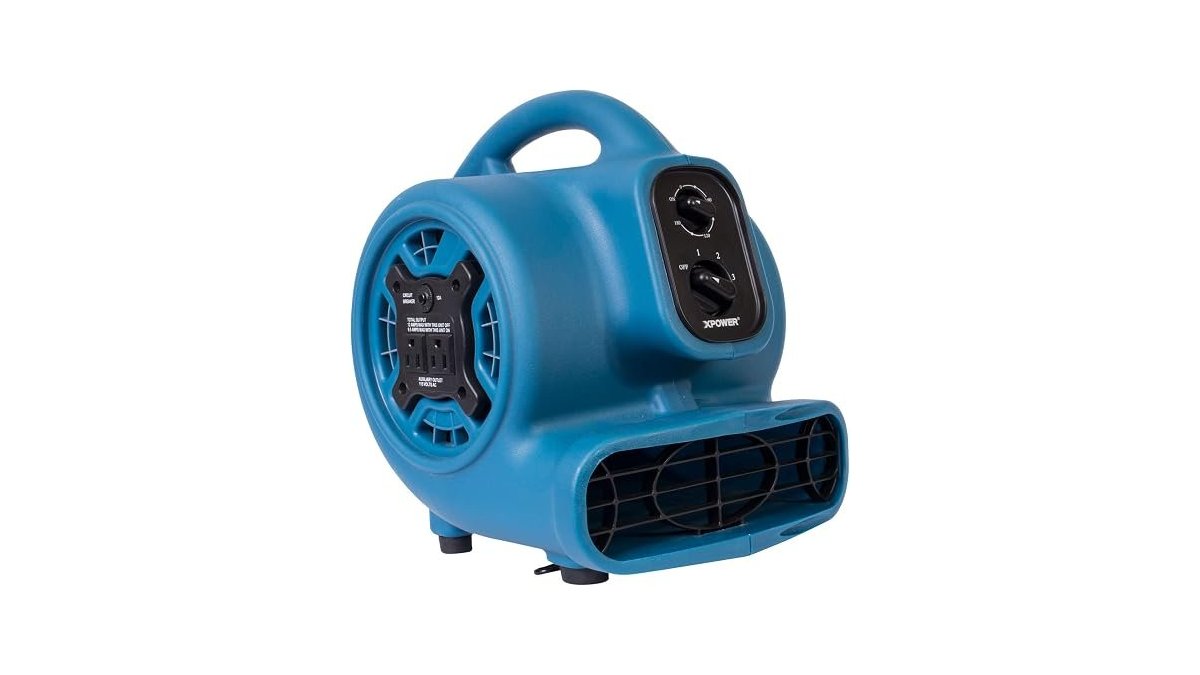
1. XPOWER P-230AT Mini Mighty 1/4 HP 925 CFM Centrifugal Air
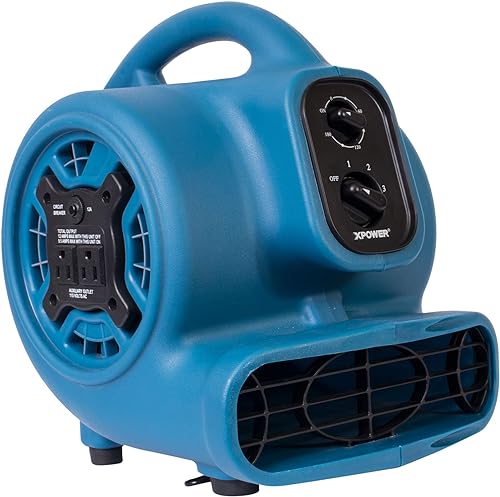
Best for: Small pours, tight rooms, and one-person jobs
The XPOWER P-230AT is a compact centrifugal air mover built around a 1/4 HP motor. The listing puts it at up to 925 CFM while drawing 2.3 Amps at its highest setting. It’s 10.7″ x 12.4″ x 13.3″ and weighs 10.2 pounds, with a durable PP housing and a 10 ft. power cord with a wrap-around design.
The listing gives a 2.3 Amp draw at its highest setting, and a daisy chain option for linking units off one feed. The 925 CFM in a body this small means it’s built for focused air on flat surfaces and tight areas rather than filling a big room. Four operating positions — 0°, 20°, 45°, and 90° — plus three speeds and a built-in timer let you aim it at the slab and walk away.
Pros
- Up to 925 CFM from a 1/4 HP motor
- Draws only 2.3 Amps at top speed
- Weighs 10.2 pounds with a carry handle
- Four operating positions and three speeds
- Stackable for storage and transport
- ETL / CETL certified with dual thermal protection
Cons
- Built for flat surfaces and tight areas, not whole rooms
Why this one: If you’re drying a small slab, a garage floor, or a bathroom pour, this is the sensible starting point. The low amp draw and light weight make it easy to place and easy to move. If you’re facing a large commercial slab, step up to the MOUNTO 1 HP 4000 CFM instead.
2. MOUNTO True 1 HP 4000 CFM 3-Speed Air Mover Blower

Best for: Big slabs and commercial drying jobs
The MOUNTO 1 HP 4000 CFM is the heavy hitter here. It runs a true 1 HP all-copper motor rated for up to 4000 CFM of airflow, built for demanding commercial and jobsite use. The housing is roto-molded, and it offers three speeds with 0°, 45°, and 90° operating positions.
Read those two numbers together and the trade-off shows up. The flip side is that this is professional-grade equipment aimed at restoration crews, construction sites, carpet cleaning, and warehouses — not a fan you tuck into a corner of a home office.
Pros
- True 1 HP all-copper motor
- Up to 4000 CFM of high-velocity airflow
- Rugged roto-molded housing for jobsites
- Three speeds and three operating positions
- Built for restoration and construction use
- U.S.-based support and replacement parts since 2014
Cons
- Sized and built for commercial jobs, not small rooms
Why this one: Take this if you’re drying a large pour and time is the constraint — a single unit moves serious volume. For a homeowner with one small slab, the XPOWER P-230AT or the MOUNTO 1200 CFM Low Profile will do the job with less machine.
3. MOUNTO 2200 CFM 1/2 HP Commercial Air Mover Floor Drying

Best for: Mid-size slabs and repeated jobsite use
The MOUNTO 2200 CFM Air Mover sits between the small units and the 1 HP machine. It uses a true 1/2 HP all-copper motor rated for up to 2200 CFM, aimed at accelerating drying on wet carpets, floors, and other surfaces. It’s built for restoration contractors, carpet cleaners, construction crews, janitorial teams, and property maintenance.
Two speeds and adjustable drying positions let you match the airflow to the surface. The design is compact with a handle and a long power cord, so it’s meant to be carried from job to job and used again and again. That’s the point of this one: it’s a working machine for people who dry floors for a living, not a throwaway gadget.
Pros
- True 1/2 HP all-copper motor
- Up to 2200 CFM of high-velocity airflow
- Two speeds with adjustable drying positions
- Handle and compact body for transport
- Long power cord included
- U.S.-based service and parts since 2014
Cons
- Two speeds rather than three
- Aimed at professional crews rather than occasional home use
Why this one: This is the pick for someone who dries floors often and wants a middle machine that carries easily. If your pour is genuinely large, the 1 HP MOUNTO covers more ground per pass. If it’s a single small slab, the low-profile MOUNTO fits tighter spots.
4. Amazon Basics 20″ High Velocity Industrial Cooling Floor Fan

Best for: High-velocity cooling and air circulation in big spaces
The Amazon Basics 20″ Floor Fan is a different animal from the air movers. It’s a high-velocity industrial fan with commercial-grade metal construction and three heavy-duty aluminum blades, rated at 3,542 CFM at high speed. It runs at multiple speeds with an adjustable tilt head, and it’s ETL listed.
The tilt head is the useful part for a slab. You can angle the airflow down across the surface rather than straight out, which is what you want when the goal is moving air over concrete. The metal housing and aluminum blades are built for demanding environments like workshops, garages, and gyms. Assembly is tool-free, so it’s running shortly after it arrives.
That 3,542 CFM figure is worth holding onto, because it tells you which jobs this fan is wrong for. Amazon Basics rates it at high speed, and the airflow is spread wide rather than concentrated. A wide column of air over a wet floor spreads the moisture around instead of pushing it toward one edge.
So the split is simple. If the space is large and the goal is circulation — a warehouse floor, an automotive repair shop, a manufacturing facility, a gym — the volume of air this moves is the point, and the pivoting mechanism keeps temperature even across the room. If the goal is drying a single spot fast, you want the focused nozzle of an air mover instead.
Pros
- 3,542 CFM at high speed
- Commercial-grade metal housing
- Three heavy-duty aluminum blades
- Three speeds with adjustable tilt head
- Tool-free assembly
- ETL listed for safety compliance
Cons
- Not purpose-built for drying, so airflow is less focused than an air mover
- Tilt head only, with no listed operating positions beyond it
Why this one: Choose this if you want one fan that also cools a garage or shop when it isn’t drying anything. If focused, aimed drying airflow is the priority, an air mover like the XPOWER P-230AT is built for exactly that.
5. MOUNTO 1/4 HP 1200 CFM Low Profile Air Mover

Best for: Tight spaces, under-furniture drying, and stacked storage
The MOUNTO 1200 CFM Low Profile runs a 1/4 HP two-speed motor rated for up to 1200 CFM. The low profile shape is the whole idea — it slides into tight spaces and fits under furniture to reach confined areas. Units stack up to five high for storage and transport.
It comes with a 25 ft 14awg power cord and a built-in 12 Amp circuit breaker, plus dual GFCI outlets that add protection against electrical hazards. It weighs 22 pounds with an ergonomic handle, and it’s made from roto-molded plastic with ETL certification. That GFCI outlet pair matters on a wet job: you can plug a second unit or a tool straight into the fan instead of running another cord across a damp floor.
Pros
- Up to 1200 CFM from a 1/4 HP two-speed motor
- Low profile fits under furniture and into tight spots
- Dual GFCI outlets built in
- 25 ft 14awg cord with 12 Amp circuit breaker
- Stacks up to five units
- ETL certified and roto-molded construction
Cons
- 22 pounds is heavier than the compact XPOWER unit
- Lower airflow than the 2200 and 4000 CFM models
Why this one: Take this when the slab is in a cramped space or you need airflow under something. The GFCI outlets and long cord make it easy to place on a wet site. For open floor area where reach isn’t the problem, the MOUNTO 2200 CFM moves more air.
6. Dri-Eaz Dri-Pod Pro Omnidirectional Floor and Carpet Dryer
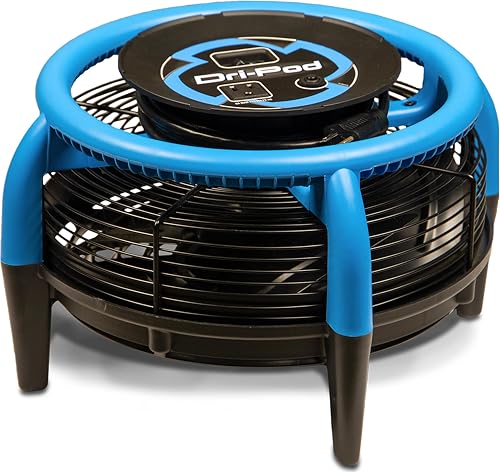
Best for: Uniform coverage in all directions across a floor
The Dri-Eaz Dri-Pod Pro is an omnidirectional floor and carpet dryer. Its defining feature is a 360-degree louvered outlet grill that pushes air several feet across a floor in every direction at once, for even coverage. It’s compact, lightweight, and designed to stack and transport to job sites.
It’s listed for commercial spaces like schools, restaurants, and hotels, and also for residential use, boats, and RVs.
Pros
- 360-degree louvered grill for all-direction airflow
- Uniform coverage across a floor area
- Lightweight and portable
- Stacks for storage and transport
- Suits commercial and residential spaces
- Works for cabinets, carpets, boats, and RVs
Cons
- Omnidirectional pattern is less focused than a directed air mover
- No CFM figure, speed count, or warranty term stated
Why this one: This is the pick if you want even drying across an open floor without repositioning a fan all day. If you’d rather aim a strong, focused stream at a specific slab, the MOUNTO 1 HP 4000 CFM or the XPOWER P-230AT does that better.
7. XPOWER FC-300 Heavy Duty Industrial High Velocity Whole Room Air

Best for: Whole-room air movement and long-distance reach
The XPOWER FC-300 is a high-CFM utility fan built for whole-room air circulation. It’s rated at 2100 CFM while drawing only 1 Amp, using a high torque motor and a spiral grille design that focuses airflow up to 120+ feet. It has a range of adjustable speeds, a 3-hour timer, and a grab-n-go handle.
The 1 Amp draw at 2100 CFM is the standout figure — that’s a lot of air movement for very little electrical load, which matters when you’re running equipment on a limited circuit. It’s ETL / CETL certified, comes fully assembled, and stacks.
Pros
- 2100 CFM while drawing only 1 Amp
- Focused airflow up to 120+ feet
- Four adjustable speeds
- 3-hour set-and-forget timer
- Fully assembled and stackable
- ETL / CETL certified with 1-year limited warranty
Cons
- Whole-room circulator rather than a focused surface dryer
Why this one: Choose this if your slab sits in a large room and you need air moving through the whole space, not just over one patch. If the job is a focused wet area, the XPOWER P-230AT or a MOUNTO air mover directs airflow better.
How to Choose a Floor Fan for Drying Wet Concrete
Pick for your own routine and your own slab, not for the longest feature list. A fan that’s awkward to place or too loud to run overnight won’t get used, and unused equipment dries nothing. Work through these questions before you decide.
- How big is the slab you actually need to dry?
- Can the circuit you’ll use handle the fan’s amp draw?
- Do you need airflow aimed at one spot, or spread across a room?
- Will you carry it up stairs or into tight spaces?
- Do you want built-in outlets to chain a second unit?
- How long do you need it to run without you checking on it?
Start with size, because it splits the field first. If you’re drying one room, a compact unit with a focused stream is enough. If you’re drying a warehouse floor or a whole commercial space, you need the volume that only a large unit moves.
Then match the airflow to the shape of the job. A 360-degree louvered grill spreads air several feet in all directions for even coverage. A pivoting head aims at one spot, which suits a freshly mopped floor or a cabinet.
Check the circuit before anything else. Amp draw varies a lot between models, and some draw very little while still moving serious air. If the fan has built-in outlets, you can chain units on one circuit instead of running extension cords.
Finally, decide how much you want to babysit it. A built-in timer and multiple speeds let a unit run while you’re elsewhere.
The Verdict for Most People
For most people drying wet concrete, the XPOWER P-230AT Air Mover is the pick. It moves up to 925 CFM while drawing only 2.3 Amps, weighs 10.2 pounds, and offers four operating positions and multiple speed settings — enough focused airflow to dry a slab without needing a dedicated circuit or a second person to move it.
The listing gives a 2.3 Amp draw at its highest setting, and at 10.2 pounds one person can reposition it as the wet area moves. Its 10-foot cord and daisy-chain option let you run more than one unit without hunting for extra outlets.
If your pour is large or commercial, take the MOUNTO 1 HP 4000 CFM instead; its 4000 CFM rating is built for that scale. And if the slab sits in a tight space, the MOUNTO 1200 CFM Low Profile slides in where a standard air mover won’t.
The rule is simple. A garage slab or a single room: P-230AT. A warehouse floor or a jobsite where the square footage keeps growing: the 4000 CFM MOUNTO. Under cabinets, furniture or a low deck: the low-profile MOUNTO. Match the machine to the slab in front of you, and the drying takes care of itself.
Frequently Asked Questions
How big a fan do I need for a wet concrete slab?
Match airflow to slab size. A compact unit rated around 925 CFM suits a small pour, a garage floor, or a bathroom. For a large slab or a commercial pour, a machine rated up to 2200 or 4000 CFM covers far more ground per pass. Bigger isn’t automatically better if the space is tight.
Can I run a floor fan overnight while the concrete dries?
Many of these units are built for extended running, and some include a timer so you can set a run period and leave it. Damp floors and electricity need care.
Will a fan actually dry concrete faster?
Moving air helps moisture leave the surface instead of sitting in a damp layer above it. It won’t replace the curing time concrete needs to reach strength, and it won’t dry a slab that’s still actively wet underneath. Used alongside good ventilation, airflow speeds up surface drying. The American Concrete Institute publishes guidance on curing and moisture in concrete.
Do these fans need a special outlet?
Not usually, but the amp draw tells you what a circuit can take. The listing gives amp draws for several units here, from 1 Amp to 2.3 Amps. If you’re running several units at once, add up the draw before plugging them into the same circuit.
What comes in the box?
Most of these arrive as a single fan unit with its power cord attached. Some include a handle, a wrap-around cord design, or built-in outlets for chaining additional units. Assembly needs vary — one model here lists a tool-free setup, while others ship fully assembled. Check the listing for what’s included before you buy.
Are these fans worth owning if I only pour concrete once?
If it’s genuinely one small pour and you have no other use, borrowing or renting may make more sense. But these fans also handle water damage, drying carpets after a leak, ventilating a garage, and cooling a workshop. If any of that sounds like your house, a fan earns its place well beyond the one pour.
