


Mixing epoxy isn’t like stirring paint. The resin is thick, the working time is short, and a batch that isn’t mixed evenly will cure soft in spots. That’s why the best drill mixer for epoxy needs low-end torque more than top speed — you want slow rotation that keeps turning when the material fights back. The wrong pick shows up fast: bubbles you can’t get out, a paddle that stalls mid-batch, or a motor that smells hot after a long mixing session.
These picks differ on three things: the speed range at the low end, the chuck size that decides which paddles fit, and how long the tool can run before it needs a rest. Every pick below is judged on the same three things — what it’s strong at, what it gives up, and what living with it would ask of you.
As an Amazon Associate, we earn from qualifying purchases. This post contains affiliate links – if you buy through them, we may earn a commission at no extra cost to you.
1. MAXXT Drill Mixer Set with Spade Handle 1/2 inch Electric

Best for: The all-rounder for mixed jobs around the shop
This is a corded mixing drill built around a 9A copper motor, and the listing leans on two things: a 360° rotating side handle and a 1/2-inch keyed chuck. The speed range runs from 0 to 600 RPM with a stated stabilization at 1000 RPM. It ships with an adaptor for mixing paddles, a 100×600mm paddle for liquid and fibrous materials, a second 100×600mm paddle, a chuck key, and a carrying bag.
That 1/2-inch keyed chuck is the detail that matters most for epoxy. A keyed chuck is tightened with a chuck key, so the paddle is held by the key rather than by hand. The trade-off is that you need the chuck key every time you swap paddles — a small thing, but it’s one more object to lose on a job site.
Strengths:
- 9A copper motor for sustained mixing loads
- 360° rotating side handle for multi-direction control
- 1/2-inch keyed chuck holds paddle shafts firmly
- Adjustable 0-600 RPM speed range
- Ships with two paddles, adaptor, chuck key, and bag
Trade-offs:
- Keyed chuck means the key is needed for every paddle change
Living with this one means keeping the chuck key somewhere you’ll find it, and matching your paddle to the material — the listing names one paddle for liquids and fibrous materials, and epoxy sits closer to that end than cement does. The rotating handle lets you reposition your grip as the batch thickens, which matters more on a long pour than a short one. You’d stop worrying about the paddle slipping, and start thinking about how many batches you can run back to back.
| Best for | Why |
|---|---|
| General epoxy and resin work | 1/2-inch chuck fits common paddles |
| Mixed-material users | Listed for cement, plaster, paint, and epoxy |
| Buyers wanting a full kit | Two paddles, adaptor, key, and bag included |
2. BOSCH GBM9-16 9 Amp 5/8 In. Mixer with D-Handle

Best for: The buyer who wants maximum torque on thick resin
Bosch’s GBM9-16 pairs a 9.0 amp motor with a 5/8-inch keyed chuck and a rotatable 360° D-handle. The listing says the motor generates outstanding torque for mixing cement, plaster, and epoxy resin, and that the variable-speed motor provides both high-torque power and high-speed drilling. The cord is 8 feet with a three-prong grounded plug.
The 5/8-inch chuck is wider than the 1/2-inch chucks on the MAXXT and VEVOR picks. That’s the practical difference: if you already own a large paddle, a wider chuck is what lets you use it.
Strengths:
- 9.0 amp motor listed for high-torque mixing
- Variable speed for both mixing and drilling
- Rotatable 360° D-handle for grip positioning
- Heavy-duty keyed chuck takes a wide range of accessories
- 8-foot rubber cord with grounded three-prong plug
Trade-offs:
- No paddle or mixing accessory is listed in the package
What this asks of an owner is simple: you supply the paddle. That’s not a flaw, but it does mean the tool isn’t ready to mix the day it arrives. Week to week, the D-handle shape suits a two-handed grip on a bucket rim, and the grounded plug is a real consideration if you’re mixing in a garage or shop with older wiring. You’d stop thinking about the tool and start thinking about your pour schedule.
| Best for | Why |
|---|---|
| Thick epoxy and resin batches | 9.0 amp motor listed for torque |
| Owners of large-shank paddles | 5/8-inch keyed chuck |
| Shop and garage work | 8-foot grounded cord |
3. VEVOR Corded Drill Mixer

Best for: The buyer who wants reach and a long cord
VEVOR’s corded mixer uses a 5/8-inch (15.89mm) chuck, a 1100W motor, and a stated 5.8A no-load current, with stepless speed control from 0 to 850 RPM. The listing describes it as both a mixer and a drill, handling paint and filler as well as drilling through various surfaces. It adds a rotating rear handle, an anti-vibration rubber grip, and a lock-on button.
The 16.4 ft / 5m cord is the standout number. On a job site, that reach decides whether you need an extension cord at all, and fewer connections means fewer places for a plug to work loose mid-batch. The trade-off is that the listing frames this as a dual-purpose machine — mixing and drilling — so it’s spread across two jobs rather than specialized for one.
Strengths:
- 5/8-inch hardened metal chuck for bit retention
- Stepless speed control from 0 to 850 RPM
- 16.4 ft / 5m cord for reach across a workspace
- Anti-vibration rubber grip and rotating rear handle
- Galvanized paddle with a smooth, easy-clean finish
Trade-offs:
- Dual mixing-and-drilling design rather than mixing alone
- No paddle size is stated in the listing
Living with this one means you’d likely leave it set up as your mixing station rather than pack it away, because the long cord rewards staying put. The lock-on button lets you run a batch without holding the trigger the whole time, which your hand notices on a thick mix. You’d stop hunting for an outlet and start working wherever the bucket happens to sit.
| Best for | Why |
|---|---|
| Large workspaces | 16.4 ft / 5m cord |
| Paint and filler jobs | Listed for paint, filler, and cement |
| Mixed drilling and mixing | Dual-purpose design |
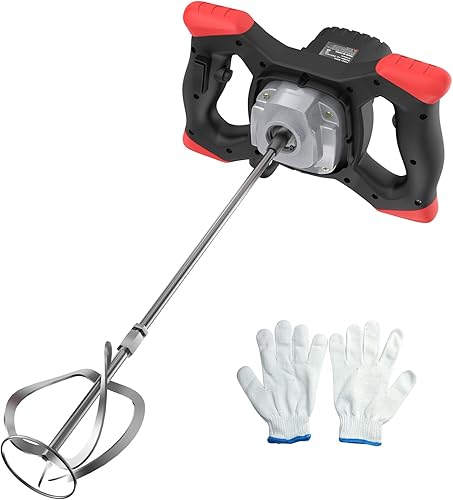
4. IMAYCC Cement Mixer 2100W
Best for: The buyer mixing big batches in one sitting
The IMAYCC mixer carries a 2100W motor with a 270-900 RPM range and six speeds, plus a self-locking switch and a screw-shaped paddle head. The listing highlights a porous heat dissipation design with automatic power-off when the tool overheats, and an all-copper carbon brush holder for maintenance. It ships with two spare carbon brushes and two installation wrenches.
The way this one moves material is the reason it suits volume. The extra contact area moves more material per rotation, so a large batch reaches an even mix sooner. The 270 RPM floor is also worth noting — it’s higher than the low end on some picks here, so very slow, bubble-sensitive pours aren’t what this tool is built for.
Strengths:
- 2100W motor with 270-900 RPM range
- Six speeds with a self-locking switch
- Screw-shaped dual-paddle for thorough mixing
- Overheating protection with automatic power-off
- Spare carbon brushes and wrenches included
Trade-offs:
- 270 RPM minimum is high for bubble-sensitive pours
- Dual ergonomic handle design is bulkier than a single grip
Owning this one means planning batches around its duty cycle rather than running it flat out all afternoon. The spare carbon brushes tell you the maker expects the tool to be serviced rather than replaced, so you’d keep them somewhere you can find them. Week to week, you’d fill a bucket, lock the switch, and let the tool do the work.
| Best for | Why |
|---|---|
| Large single batches | Dual-paddle mixing design |
| Long-term owners | Spare carbon brushes included |
| Cement, grout, and plaster | Listed for mortar, plaster, and thinset |
5. SILVEL Cement Mixer

Best for: The buyer who wants to dial in speed by material
SILVEL’s mixer runs a 2300W/110V copper motor with six speed gears, a dual steering wheel handle, and a self-locking switch. The listing names a high-efficiency ventilation system with overheating protection, and describes the body as light, anti-impact, and rust-proof. Simple accessories are listed as easy to assemble, use, and replace.
Six gears is the pitch here, and it’s a real difference from stepless control: fixed steps are easier to repeat. If a batch mixed well on gear three, you can go back to gear three. The trade-off is that the listing states no RPM figures for those six gears, so you can’t tell from the page how slow the lowest one actually turns.
Strengths:
- 2300W/110V copper motor
- Six speed gears with self-locking switch
- Ventilation system with overheating protection
- Dual steering wheel handle for control
- Rust-proof, anti-impact body material
Trade-offs:
- No RPM range is stated for the six gears
- Listing names no paddle or accessory in the package
What this asks of an owner is a little trial and error in the first week — you’d work through the gears to find which one suits your resin, then stay there. The steering wheel handle spreads the load across both hands, which helps on a long mix. You’d stop adjusting mid-batch and start repeating a setting you trust.
| Best for | Why |
|---|---|
| Repeatable mixing results | Six fixed speed gears |
| Slurry, cement, and paint | Listed for slurry, mortar, and paint |
| Two-handed control | Dual steering wheel handle |
6. CS Unitec EHR 18.1 S

Best for: The buyer who wants a light tool for medium batches
The EHR 18.1 S is a compact mixing drill with a 9.5 amp motor, a free speed of 800 RPM, and a load speed range of 0-450 RPM. The listing states it handles 2-bag batches or 20 gallons with output up to 700 lbs. per hour, and it’s made in Germany. It weighs 9 lbs and includes a soft start, a safety trigger lock, and a labyrinth guide motor cap against dust, dirt, stones, and water splashes.
The 9 lb figure is the number worth noting, and the listing pairs it with an ergonomic upright working position. The trade-off is capacity: 20 gallons is the stated ceiling, so this is a medium-batch tool, not a production mixer.
Strengths:
- 9.5 amp motor with 0-450 RPM load speed
- Listed for epoxy, coatings, and leveling compounds
- 9 lbs with an ergonomic upright working position
- Soft start and safety trigger lock
- Labyrinth guide motor cap resists dust and splashes
Trade-offs:
- Stated ceiling of 2-bag batches or 20 gallons
- Higher free speed of 800 RPM than load speed
Living with this one means you’d mix in comfortable batches rather than pushing the tool past its stated capacity. The soft start is listed alongside the safety trigger lock for secure operation. You’d stop bracing against the torque and start working upright, which is the whole point of the design.
| Best for | Why |
|---|---|
| Medium epoxy batches | Stated 20-gallon capacity |
| All-day comfort | 9 lbs with upright working position |
| Dusty or splash-prone shops | Labyrinth guide motor cap |
7. CS Unitec EHR 23/1.4 R

Best for: The buyer running high-viscosity mixes all day
This is the heavy end of the range: a 14.5 amp motor, a stated capacity of 5 bags or 25 gallons (200 lbs) of high-viscosity material, and output up to 1800 lbs. per hour. Free speeds run 150-325 RPM with load speeds of 100-275 RPM. It weighs 15 lbs, includes integrated frame bumpers, and comes with the MG 160 paddle at 6.25″ diameter, with WG 160, MG 160, and TWP 160 paddles listed as options.
The 100 RPM load speed floor is the number that matters for epoxy. Slow rotation is how you avoid folding air into resin, and this tool’s low end goes lower than most here.
Strengths:
- 14.5 amp motor for continuous demanding use
- Stated 5 bags or 25 gallons (200 lbs) capacity
- 100-275 RPM load speed range for slow mixing
- Integrated frame bumpers against drops
- MG 160 paddle included, with optional paddles listed
Trade-offs:
- 15 lbs makes it a two-handed tool
- Optional paddles are listed separately from the included one
Owning this one means committing to it as a dedicated mixing station rather than a tool you carry around. The variable speed lets you start slow and stay slow, which is exactly what high-viscosity epoxy wants. You’d stop worrying about whether the tool can handle the batch and start worrying about whether your bucket can.
| Best for | Why |
|---|---|
| High-viscosity epoxy and resins | 100-275 RPM load speed range |
| Large-scale projects | Stated 200 lbs capacity |
| Rough job sites | Integrated frame bumpers |
8. Upgraded Resin Mixer

Best for: The crafter mixing small resin batches by hand
This is a different kind of tool — a handheld rechargeable mixer with a 50-300 RPM range, a 1500mAh battery, and USB-C charging. The listing says the speed is controlled so that even at maximum it won’t produce a lot of bubbles, and it uses a larger torque motor rated to 200 with forward and reverse modes. It ships with four reusable paddles in two sizes, a USB Type-C cable, and a manual.
The 50 RPM floor is the lowest here by a wide margin, and that’s the whole case for it: slow rotation is how you keep bubbles out of a small pour. The trade-off is scale — this is a handheld stirrer for cups and small molds, not a bucket tool, and charging takes 4-6 hours per the listing.
Strengths:
- 50-300 RPM range aimed at reducing bubbles
- Rechargeable 1500mAh battery with USB-C charging
- Forward and reverse mixing modes
- Four reusable paddles included
- Paddles clean with wipes or warm water
Trade-offs:
- 4-6 hour charge time per the listing
- Suited to small batches rather than buckets
Living with this one means charging it after each session so it’s ready when you are. The paddles are listed as reusable and easy to clean, and the listing describes peeling the epoxy off once it has dried. You’d stop dreading the wrist work of stirring by hand and start mixing small pours in seconds.
| Best for | Why |
|---|---|
| Small resin pours and molds | 50 RPM low-end speed |
| Crafters without a corded drill | Rechargeable with USB-C |
| Bubble-sensitive projects | Listed for minimizing bubbles |
Side by Side
The table below lines up the picks on the things that decide an epoxy mix — speed range, chuck size, stated capacity, and what comes in the box — so you can see where each one gives ground before you choose.
How to Judge One of These
The Low End of the Speed Range
Top speed sells a mixer. Low speed is what actually mixes epoxy. Resin and hardener need to be folded together slowly, because fast rotation whips air into the batch and air that cures in place becomes a bubble you can’t sand out. A tool that starts at 50 RPM gives you room to work slowly; one that starts at 270 RPM is already moving faster than a careful pour wants.
Look at the load speed, not the free speed. Free speed is what the tool turns with nothing attached. Load speed is what it holds once a paddle is buried in thick resin, and that’s the number you’ll actually feel. A listing that gives both, like the CS Unitec picks, tells you more than one that gives only a single figure.
Before ordering, confirm the lowest speed the tool will hold under load. If the listing only prints one RPM number, treat it as the free speed and expect less under load. For small pours, a low-speed handheld stirrer does the job. For buckets, you want a tool whose slow end stays slow.
Chuck Size and Paddle Fit
The chuck is the joint between the tool and the paddle, and it decides which paddles you can use. A 1/2-inch chuck fits most common mixing paddles. A 5/8-inch chuck opens up heavier shanks.
There’s a second question most buyers miss: does the tool come with a paddle at all? Some listings include one or two, plus an adaptor. Others ship the tool alone. Neither is wrong, but it changes what you do on day one — one arrives ready to mix, the other needs a paddle before it does anything.
Check two things before ordering. First, the chuck size, written as a fraction of an inch. Second, whether a paddle is in the package list. If it isn’t, order one that matches your chuck and your material. The OSHA hand and power tools guidance is a useful starting point for safe setup and grip on a tool like this.
Duty Cycle and Overheating Protection
Mixing epoxy loads a motor differently than drilling does. The paddle stays buried, the resistance never lets up, and heat builds in the windings. That’s why duty cycle matters more here than in most power tools. A tool rated for continuous mixing can run a long batch; one that isn’t will tell you by getting hot.
Some listings name the protection directly — automatic power-off when overheated, ventilation systems, porous heat dissipation. Others state a capacity ceiling instead, like 2-bag batches or 25 gallons, which is really a duty-cycle limit in different words. Both are useful. What you want to know is how long the tool can run before it needs a break.
Before ordering, find the stated batch capacity or the continuous-run rating. Then plan your session around it: mix, set the tool down, and let it cool while you prep the next bucket.
What the Accessories Actually Cover
A mixer’s box contents tell you what the first week looks like. A spare paddle means you can keep one for liquids and one for thicker material. A chuck key means the chuck is keyed. A carrying bag means the tool is meant to travel. Spare carbon brushes mean the maker expects you to service it rather than replace it.
The feature that sells the product and rarely earns its place is the drill function. Many mixing tools are also sold as drills, and that sounds like two tools for one purchase. In practice, you’re buying a mixer, and the drilling claim is unlikely to change how you use it. Judge the tool as a mixer first.
Before ordering, read the package list line by line and ask what you’d still need to buy. If no paddle is listed, that’s your first purchase. If spare brushes are included, note the size so you can reorder the same ones.
Closing
For most people mixing epoxy in a bucket, the MAXXT Drill Mixer Set covers the common case — a 1/2-inch keyed chuck, a 0-600 RPM range, and two paddles in the box. If your need is unusual — very small pours where bubbles are the whole problem — the Upgraded Resin Mixer and its 50-300 RPM range is built for exactly that. Next step: check the chuck size of any paddle you already own, then match it to the pick above that fits.


