

Epoxy Primers for Concrete
A good epoxy primer bonds your topcoat to the slab, so the finish stays put instead of peeling.
It’s Saturday morning. You’ve cleared the garage, swept the floor twice, and the kids’ bikes are stacked in the yard. You promised yourself the floor would be done before the weekend ends — but the concrete is bare, dusty, and has a few old oil stains near where the car parks. The coating can is sitting there, and you know from a neighbor’s story that skipping the primer step is how floors start lifting at the edges a year later.
That’s what a primer for concrete fixes. It goes down first and gives the topcoat something to grip, which matters most on smooth, sealed, or previously painted slabs where paint alone slides off. Some also slow moisture vapor coming up through the slab, which is a common cause of bubbles and peeling. The picks below cover different floors and different jobs, so you can match one to yours.
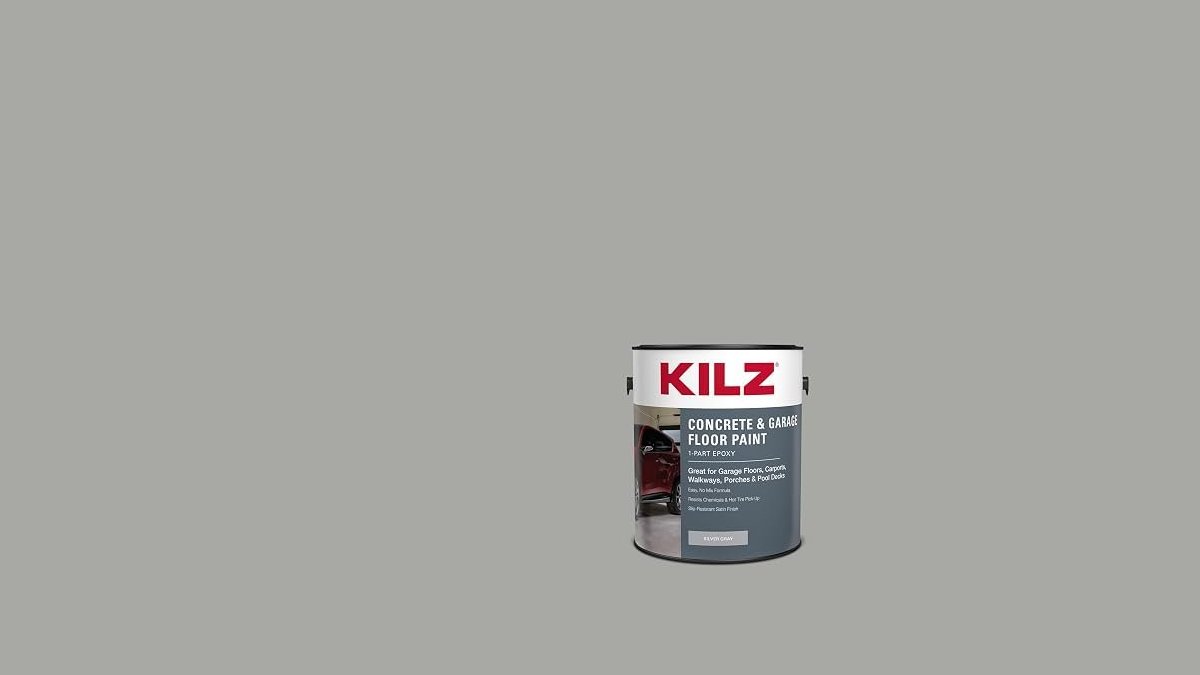
1. KILZ 1-Part Epoxy Concrete & Garage Floor Paint

Best for: Garage and basement floors on bare concrete
This is a one-part epoxy acrylic coating from KILZ, a brand that’s been in surface coatings for over 50 years. The listing describes it as a floor paint and primer for both indoor and outdoor horizontal surfaces — basements, garage floors, porches, driveways, and pool decks. It goes on porous concrete, masonry, stone, and brick with a roller or brush, and cleans up with soap and water.
Because it’s a one-part water-based product, you open the can and start rolling — no measuring, no mixing window to beat. The listing says it covers 300–400 sq. ft. per gallon on smooth surfaces and 200–300 on rough, so a rough, pitted garage slab will drink more of it than a troweled one. It’s also listed as not for vertical surfaces, and not for areas with hydrostatic pressure or forklift traffic.
Pros
- One-part formula, no mixing required
- Roller or brush application, soap and water cleanup
- Listed for interior and exterior horizontal surfaces
- Resists hot tire pickup, scuffing, cracking, and peeling
- Covers 300–400 sq. ft. per gallon on smooth concrete
- Low-VOC, water-based
Cons
- Not for vertical surfaces
- Not for slabs with hydrostatic pressure or forklift traffic
- Residential use only
Why this one: Take it if you want a straightforward primer and floor coating for a home garage, basement, or porch slab that’s bare and properly prepared. If your slab is damp or you’re coating over an existing sealer, look at the Rust-Oleum recoat primer or the two-part kits instead.
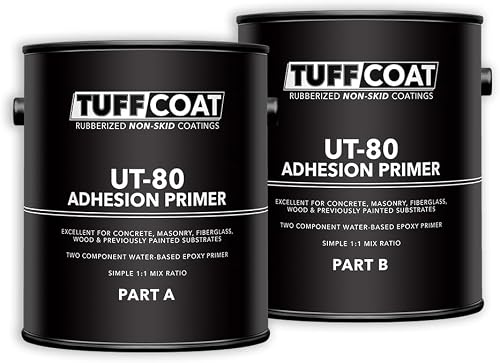
2. Tuff Coat UT-80 Adhesion Primer
Best for: Damp slabs and mixed or previously painted surfaces
Tuff Coat UT-80 is a two-component water-based epoxy primer and sealer in a gallon kit. The listing says it works on concrete, masonry, fiberglass, wood, and previously painted substrates, and that it can go onto damp concrete. It uses a simple 1:1 mix ratio and is compatible with all Tuff Coat rubberized non-skid coatings.
The damp-surface claim is the one that changes your day: the listing says it can be applied to damp concrete. The mixed substrates matter too — if your project touches concrete plus a wood step or a fiberglass edge, one primer covering all of them saves you buying a second product. The trade-off is that it arrives as separate parts you must combine, and you finish within the working life of the batch.
Pros
- Two-component water-based epoxy primer and sealer
- Simple 1:1 mix ratio
- Can be applied to damp concrete
- Works on concrete, masonry, fiberglass, wood, painted surfaces
- For heavy use and moisture areas
- Compatible with Tuff Coat rubberized non-skid coatings
Cons
- Requires mixing before use
- Mixed batch has a limited working time
Why this one: Choose it when the slab is damp, or when your project mixes concrete with wood, fiberglass, or old paint. If you’re coating a dry garage floor and want to skip mixing entirely, the KILZ primer that comes ready to use is the simpler route.
3. Rust-Oleum Concrete & Garage Gray Recoat Primer

Best for: Coating over an already sealed garage floor
This is a one-part water-based primer built specifically for recoating. The listing says it coats directly over previously coated or sealed concrete floors with no sanding or grinding, and it dries in as little as 6 hours so most topcoats go on the same day. One gallon covers up to 400 square feet, and only one coat is recommended.
This primer exists to skip that step, which is why it earns its place here.
Pros
- No sanding or grinding over coated or sealed floors
- Dries in as little as 6 hours
- Topcoat can go on the same day
- Covers up to 400 sq. ft. per coat
- Compatible with most Rust-Oleum floor coatings
- Low odor, water-based formula
Cons
- Only one coat recommended
- Coverage figure is for a single coat
Why this one: This is the pick if your garage floor already has a coating or sealer and you don’t want to grind it off. If your slab is bare and never coated, the KILZ primer or a mix-it-yourself kit is the more direct match.
4. INSL-X SXA11009A-04 Stix Acrylic Waterborne Bonding Primer

Best for: Glossy, sealed, and hard-to-stick surfaces
Stix is an acrylic-urethane bonding primer-sealer. The listing claims adhesion to challenging surfaces including glossy tile, PVC, vinyl, plastic, glass, glazed block, glossy paint, pre-coated siding, fiberglass, and galvanized metal, plus drywall, plaster, wood, masonry, stucco, concrete, and cement block. It can be top coated with almost any product and fully cures at temperatures as low as 35 °F.
Coverage is listed at 75–100 square feet, which is small — this is a quart, and it’s a bonding primer rather than a full-floor coating, so it suits patching, edges, and small areas. It’s low VOC with soap and water cleanup, and the listing points you to the label for prep and application.
Pros
- Bonds to glossy tile, PVC, vinyl, glass, and glazed block
- Cures at temperatures as low as 35 °F
- Top coat with almost any product
- Low VOC, soap and water cleanup
- Good enamel holdout for an even topcoat
- Works indoors and outdoors
Cons
- Listed coverage is 75–100 sq. ft.
- Supplied as a 1 quart container
Why this one: Take it for small areas and awkward surfaces — glossy patches, tile, metal edges, or a cold garage. If you’re priming a whole floor, the coverage here won’t stretch far enough and a gallon-size floor primer fits better.
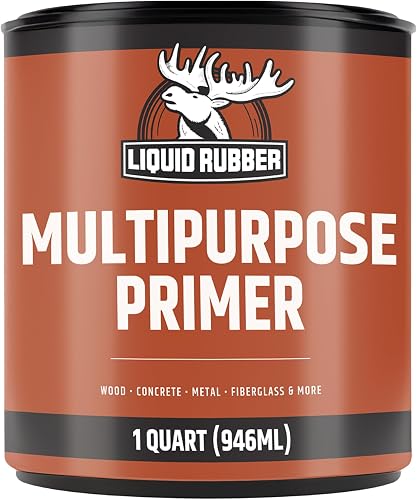
5. Liquid Rubber Multipurpose Primer
Best for: Mixed DIY projects with wood, concrete, and metal
This is a water-based, non-toxic multi-purpose primer from Liquid Rubber, described as a high-performance bonding agent that improves adhesion and prevents blistering. The listing names concrete, wood, and high-density polyethylene among the surfaces it suits, and says it dries fast. Apply with a brush, roller, or spray equipment, one to two coats depending on the surface, and top coat within 24 hours once tack free.
The application notes are specific: dry surface, free of dirt, debris, oil, silicone, laitance, and efflorescence, and don’t apply before rain or if dew is forecast.
Pros
- Water-based, non-toxic, low VOC
- Listed for concrete, wood, and high-density polyethylene
- Improves adhesion and prevents blistering
- Brush, roller, or spray application
- One to two coats depending on surface
- Fast drying
Cons
- Top coat must go on within 24 hours when tack free
- Not for application before rain or forecast dew
Why this one: Good for a mixed-material project where concrete is only part of the job, and for anyone who wants a low-odor, water-based product. If you’re priming a full garage slab, a dedicated floor primer covers more ground per container.
6. Stone Coat Countertops Epoxy Undercoat White (1 Quart)

Best for: Countertop and bar top epoxy projects
This is a white epoxy undercoat from Stone Coat Countertops, meant to go under their epoxy resin kits. The listing says two coats create a firm, sealed foundation that gives the surface a denser, thicker look and extends its lifespan. It’s listed for countertops, table tops, bar tops, cabinets, appliances, MDF, and plywood, applied with a microfiber roller kit.
Read the coverage carefully before you plan the job. The listing states one quart covers up to 40 square feet, which it describes as enough for a 2 gallon Stone Coat Countertops epoxy kit. That’s a countertop-sized figure, not a floor-sized one — so this is the wrong product for a garage slab, and the right one for a kitchen or bar top where you want a solid white base under the resin. It’s described as non-toxic with small amounts of titanium dioxide, non-hazardous, and suitable indoors and outdoors.
Pros
- Creates a sealed foundation under epoxy resin
- Listed for countertops, bar tops, tables, cabinets, MDF, plywood
- Two-coat application with a microfiber roller
- Non-toxic, non-hazardous, easy to wash off
- Suitable for indoor and outdoor use
- Made for use with Stone Coat Countertops epoxy kits
Cons
- Listed coverage is up to 40 sq. ft. per quart
- Designed around Stone Coat Countertops epoxy kits
Why this one: Pick it if you’re pouring epoxy on a countertop, bar top, or table and want a white base under it. For a floor, skip it — the coverage is sized for a counter, not a slab.
7. Stone Coat Countertops Bonding Primer & Sealer

Best for: Slick countertop surfaces before epoxy
This is a bonding primer and sealer in translucent white, described as the improved replacement for XIM UMA Primer. The listing says it creates a durable bond on slick surfaces like laminate, tile, granite, quartz, solid surface, and cultured marble, giving a strong foundation for epoxy. It’s low odor and low VOC, and cleans up with warm soapy water.
The surfaces named here are the ones the listing calls slick, and it says the primer creates a durable bond on them. The application is roll on two coats with a microfiber roller and sand lightly between layers. That sanding step is small but it’s part of the job, so plan for the extra pass. It’s water-based, so cleanup is quick.
Pros
- Bonds to laminate, tile, granite, quartz, and cultured marble
- Low odor and low VOC for indoor work
- Water-based with warm soapy water cleanup
- Roll on with a microfiber roller
- Improved replacement for XIM UMA Primer
- Translucent white finish
Cons
- Two coats required
- Light sanding needed between coats
Why this one: Choose it for a countertop refinish over laminate, tile, or stone where grip is the whole problem. If you’re sealing a concrete floor instead, a floor primer is the better fit.
8. Kelley Technical Coatings Olympic Poxoprime II Primer

Best for: Two-part epoxy systems on large slabs
Poxoprime II is a two-part epoxy primer from Kelley Technical Coatings, sold as a 1 gallon base plus a 1 quart catalyst. The listing notes the gallon is short filled so the catalyst can be mixed in for a finished single gallon of mixed paint, and it must be thoroughly mixed before use. Coverage is listed at approximately 200–250 square feet per gallon.
The short-filled can is a detail worth understanding before you open the box — it looks like a mistake and it isn’t. Mix the whole catalyst in and you have your working gallon. The listing also carries a rebranding note: Kelley Technical Coatings and Olympic Pool Paint are moving to Smart Seal by Olympic, so stock may arrive with one label, both, or different color options. It also states results can’t be guaranteed and that screens may not show color accurately, with a color card suggested for accuracy.
Pros
- Two-part epoxy primer system
- Includes 1 gallon base and 1 quart catalyst
- Approximately 200–250 sq. ft. per gallon
- Must be thoroughly mixed before use
- From Kelley Technical Coatings
Cons
- Requires thorough mixing of base and catalyst
- Listing states results can’t be guaranteed
- Labels and color options may vary during rebranding
Why this one: Take it if you want a two-part epoxy primer for a large slab and you’re comfortable mixing. If you’d rather not measure and mix, the one-part KILZ or Rust-Oleum primers remove that step.
9. 2-Part Epoxy Floor Primer

Best for: Full floor systems with moisture concerns
This is a clear two-part epoxy primer kit, 1.5 gallons total, from POURLA. The listing describes it as a moisture vapor barrier on prepared slabs, tested to ASTM E96 at 0.051 g/(m²·h) and 0.176 US Perms, to help reduce moisture vapor linked to peeling and delamination. It’s listed for garage floors, basements, workshops, warehouses, and commercial spaces, under flake, metallic, solid-color, or clear coatings.
The numbers here are the reason it leads the floor-kit category. Adhesion is listed as ASTM D4541-22 tested at 10 MPa / 1450.38 psi, and coverage at approximately 225–300 sq. ft. per 1.5 gallon kit, depending on porosity and profile. Mix Part A and Part B at 2A:1B by weight and use within roughly 40 minutes at 77 °F. Apply with a 3/8-inch shed-resistant roller, keep a wet edge, and recoat when walkable without impressions, typically 6–12 hours. The listing gives an approximate 40-minute working time at 77 °F, so mix in batches you can roll out.
Pros
- Clear moisture vapor barrier on prepared slabs
- ASTM E96 tested for moisture vapor
- ASTM D4541-22 adhesion tested at 10 MPa
- 1.5 gallon two-part kit, 2A:1B by weight
- Listed for garages, basements, workshops, warehouses
- Recoat typically in 6–12 hours
Cons
- Approximately 40-minute working time at 77 °F
- Requires mechanical profiling of clean, dry concrete
Why this one: This is the pick for a full floor system where moisture vapor is a real worry, and it’s the one that publishes its test figures. If you’re coating a small area or recoating an existing floor, a one-part primer is a simpler job.
How to Choose Yours
Choose on your own routine and your own slab, not on the longest feature list. The primer that fits your floor, your timeline, and your comfort with mixing will beat a fancier one you never finish applying.
- Is your concrete bare, or does it already have a coating or sealer on it?
- Does the slab stay damp, or have you seen moisture coming through it?
- How much floor area do you need to cover in one go?
- Are you willing to measure and mix two components, or do you want to open a can?
- What temperature will the space be while the primer cures?
- Will anything roll or drive over the finished floor, like a car or a cart?
The Verdict for Most People
For most readers coating a bare home garage, basement, or porch slab, the KILZ 1-Part Epoxy Concrete Primer is the pick. It covers a real floor area per gallon, needs no mixing, cleans up with soap and water, and it’s listed for both interior and exterior horizontal concrete.
Take a different one if your situation is different. If the floor already has a coating or sealer, the Rust-Oleum Concrete Recoat Primer is built for that job with no sanding or grinding. If moisture vapor worries you, the POURLA 2-Part Epoxy Floor Primer publishes its own test figures for that. Match the primer to your slab, and the topcoat has a fair chance of staying where you put it.
As an Amazon Associate, we earn from qualifying purchases. This post contains affiliate links – if you buy through them, we may earn a commission at no extra cost to you.


