
Picture this: You finally have a free weekend to transform your dusty, oil-stained garage floor. You walk into a giant home improvement store and head straight down the paint aisle. On one side, you see a cheap, friendly can of floor paint promising a quick splash of color.
On the other side, you see a heavier box kit with a “two-part” resin mixture that looks like a high school chemistry project.
If you choose the cheap can just to save a few bucks, you might find yourself regretting it big time in less than a year. When it comes to choosing between concrete floor paint vs epoxy, making the wrong call usually means you will be on your hands and knees scraping up peeling flakes of plastic before you know it.
Why does this happen? Let us break down the sneaky differences between these two options so you do not waste your hard-earned cash or your precious weekend.
The Molecular Truth: Evaporation Drying vs. Chemical Curing
To understand why one floor looks amazing for decades while the other peels off like an old sticker, we have to look at what happens after you roll the liquid out. It all comes down to a big difference in how they dry.
How Standard Concrete Paint Works
Standard floor paint is usually an acrylic latex formula. It behaves exactly like the paint you slap on your bedroom walls, just formulated slightly tougher for a slab.
When you roll paint onto your garage floor, it is packed with water or solvents that keep it liquid in the can. As soon as it hits the air, those liquids start to evaporate into the room. What is left behind? A very thin, topical layer of plastic film.
This dried film is usually only about 1 to 2 mils thick (a mil is just a tiny fraction of an inch!). Because it dries purely by evaporation, the molecules never link up tightly. They just sit loosely on top of the concrete, holding on for death with weak surface tension.
How True Two-Part Epoxy Systems Work
A real two-part epoxy coating does not care about evaporation. In fact, it does not “dry” at all—it cures.
When you buy a real kit, you get a resin (Part A) and a polyamine hardener (Part B). The second you mix those two liquids together, a chemical reaction starts. This reaction creates heat—which you can actually feel if you leave the mixed bucket sitting too long—and causes the molecules to cross-link.
This cross-linking process turns the liquid into an incredibly dense, rigid, and solid plastic lattice. Instead of just sitting on top of your floor, it creates a powerful mechanical bond.
It flows deep into the microscopic pores of your concrete slab, locking onto it like a million tiny roots. When it sets, it forms a thick wear layer that is usually 10 to 30 times thicker than a simple layer of paint.
Deconstructing the “1-Part Epoxy Paint” Gimmick
Have you ever seen a can at the store labeled “1-Part Epoxy Paint” and thought, “Oh wow, the best of both worlds!”?
I hate to break it to you, but that is mostly just clever marketing fluff.
When manufacturers make 1-part “epoxy paint,” they take regular old water-based acrylic paint and mix in a tiny, single drop of epoxy resin just so they can legally print the word on the label. Because it is all pre-mixed in a single can, there is no second chemical hardener to kick off a real cure.
My personal opinion? It is a total trap for DIY enthusiasts. It might perform a tiny bit better than basic wall paint, but it completely lacks the cross-linked strength of a real two-part resin system. If you want real protection for a hardworking floor, a single-can product simply will not cut it.
Comparing the Grip: Surface Tension vs. Tensile Bond Strength
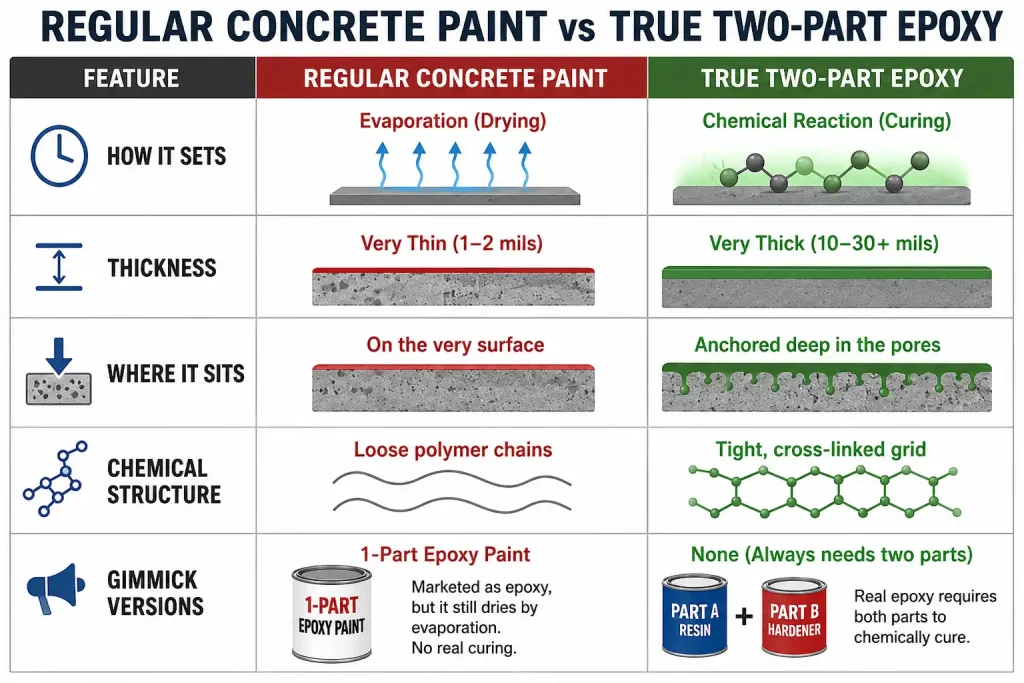
Ever wonder why paint peels up in big sheets while industrial coatings stick around forever? It comes down to a battle of engineering metrics: topical friction versus tensile bond strength.
- Concrete Floor Paint: It relies on simple topical grip. Think of it like a piece of tape stuck to a sidewalk. It stays there if you leave it alone, but any real scraping or pulling force will snap that weak bond instantly.
- Two-Part Resin Coating: It creates a deep chemical anchor. The epoxy liquid flows into the open pores of the concrete before the cross-linking finishes.
Once a high-quality epoxy cures, its hold is actually stronger than the concrete itself! If you tried to force it off, the concrete underneath would crack and break away before the epoxy layer unglued itself.
To help you see the whole picture at a glance, here is a quick breakdown of how these two stacks up on a technical level:
| Feature | Regular Concrete Paint | True Two-Part Epoxy |
| How it sets | Evaporation (Drying) | Chemical Reaction (Curing) |
| Thickness | Very Thin (1–2 mils) | Very Thick (10–30+ mils) |
| Where it sits | On the very surface | Anchored deep in the pores |
| Chemical structure | Loose polymer chains | Tight, cross-linked grid |
| Gimmick versions | 1-Part Epoxy Paint | None (Always needs two parts) |
Destructive Failure Modes & Industrial Testing Realities
Ever wonder why a newly painted floor looks spectacular on Sunday but starts coming apart by Friday? It is because real-life floors have to deal with intense physical stress, trapped water, and nasty chemicals. Let us look at what happens when these two floor choices face real-world torture tests.
The Physics of Hot Tire Pickup
If you are a homeowner parking a car in a garage, this is the absolute biggest issue you will face. It is a frustrating problem called hot tire pickup, and it ruins thousands of painted floors every single year.
Hot Tires Park
Warm, flexible tires are parked on a weak paint or coating, softening the contact area.
Tires Cool
As the tires cool, the rubber contracts and can grip the coating more tightly.
Vehicle Moves
When the vehicle drives away, the tire’s grip can pull up a poorly bonded coating, causing peeling or delamination.
Hot tire pickup occurs when a coating lacks sufficient adhesion or durability to withstand the stresses created by warm vehicle tires. Quality two-part epoxy and polyaspartic systems are designed to resist this problem, while lower-performance paints or improperly prepared coatings are much more susceptible.
When you drive your car down the highway, your tires get hot from rubbing against the asphalt. This heat causes the rubber to expand slightly. When you pull into your garage and park, the hot tires press down hard against the cool floor.
As the rubber cools over the next few hours, it contracts and shrinks. If you have standard floor paint, that cooling rubber creates a localized vacuum bond with the thin plastic paint film. The next time you back your car out of the garage, the tire wins the tug-of-war. It literally rips the weak paint right off the concrete slab, leaving ugly, bare black tire marks behind.
A real cross-linked epoxy system laughs at hot tires. Because its heat resistance is so high and its anchor is deep in the concrete pores, the cooling rubber cannot break its grip.
Related Article: How to Clean Epoxy Coated Garage Floors?
The Sub-Slab Enemy: Moisture Vapor Transmission (MVT)
Here is a huge secret that most big-box paint brands will never tell you: concrete looks solid, but it actually acts like a giant sponge.
Deep under your home, there is moisture in the dirt. Thanks to a natural process called capillary action, that moisture gets sucked upward through the concrete slab toward the air in your room. This movement of water is called moisture vapor transmission (or MVT), and it is a silent paint killer.
- What happens to paint: Floor paint forms a very weak, brittle vapor barrier on top of the slab. When water vapor rises and hits the underside of that paint layer, it gets trapped. The water builds up, creating hydrostatic pressure. This pressure easily pushes the thin paint film up, causing immediate blistering, bubbling, and continuous flaking.
- What happens to epoxy: High-quality industrial epoxies are designed to handle this pressure. They have incredible resistance to moisture vapor, sealing the slab completely so water cannot push the coating off the floor.
If you do not test your slab for moisture before putting down a cheap paint, you are basically throwing your money into a wishing well.
To understand visually, please watch this youtube video-
Chemical Degradation Dynamics
Garages and workspaces are messy places. Whether you are doing a simple oil change or accidentally dropping a bottle of household cleaner, your floor is bound to meet some harsh liquids.
Regular concrete floor paint uses weak, open-chain polymers. When aggressive automotive fluids like brake fluid, gasoline, battery acid, or even harsh winter road salts sit on a painted floor, they act like paint thinner. They quickly liquefy, dissolve, or heavily stain the paint. Before you know it, you are looking at an un-wipeable, sticky mess.
A true two-part resin system is completely chemically inert once it cures. The tight, cross-linked molecular grid blocks chemicals from penetrating the surface. You can spill oil, wipe it up hours later with a rag, and the floor will look as good as new.
The Imperative of Concrete Surface Profile (CSP)
You cannot build a strong house on a weak foundation, and you cannot put a great coating on unprepared concrete. This is where the concept of concrete surface profile (CSP) comes into play. The International Concrete Repair Institute (ICRI) rates how rough a floor is on a scale from CSP 1 (smooth as glass) to CSP 9 (rough like heavy gravel).
Best for Paint & Thin Sealers
Acid Etching • Water-Based Epoxy
Industrial & 100% Solids Epoxy
The Concrete Surface Profile (CSP) measures how rough the concrete surface is after preparation. As the CSP increases, the coating has more texture to grip, creating stronger mechanical adhesion. Most residential epoxy systems perform best on a CSP 2–3 surface produced by acid etching or diamond grinding, depending on the coating manufacturer’s specifications.
- Paint preparation: Floor paint is thin, so people usually just slap it down after a quick pressure washing. It might stick to a smooth surface for a moment, but without microscopic grooves to hold onto, it will fail fast.
- Epoxy preparation: Real epoxy requires a rougher texture to mechanical lock into place—specifically a CSP 2 or CSP 3 profile. To get this, you must open up the concrete’s micro-capillaries. This is done by mechanical diamond grinding or acid etching.
Skipping this step is the number one reason DIY projects fail. If you do not grind the floor to open up those pores, even the most expensive epoxy will slide right off the surface.
Lifecycle Value Engineering: Why “Cheap” Costs More
Now let us look at the true dollars and cents. A lot of property managers and homeowners pick paint because the upfront price tags look amazing. A gallon of concrete paint might run you $40, while a professional-grade multi-layer resin kit can cost a few hundred bucks. But what happens over a 10-year timeline?
With paint, you are trapped in a vicious cycle. Because it suffers from hot tire pickup and scuffing, you have to scrape it, clean it, and reapply it every 12 to 18 months. When you calculate the cost of your time, the extra paint rollers, and the continuous frustration, that cheap fix quickly turns into a massive money pit.
A premium two-part system might cost more on day one, but it regularly lasts 15+ years without flaking. In the long run, the industrial-grade system is actually the true budget-friendly option.
The Advanced Multi-Layer System Upgrade
If you want the absolute ultimate level of protection, you shouldn’t just stop at a single coat of basic epoxy. The absolute best way to protect a hardworking floor is to build a layered shield.
- The Primer Layer: A low-viscosity, moisture-mitigating primer base coat that dives incredibly deep into the concrete pores to block out rising water vapor.
- The Build Layer: A thick, 100% solids epoxy layer that fills in small cracks, builds up thickness, and holds decorative color flakes or quartz beads.
- The Topcoat Layer: A high-performance polyaspartic topcoat or polyurethane layer. Standard epoxy is sensitive to ultraviolet light and will turn a nasty yellow or amber color if it gets hit by sunlight. A polyaspartic topcoat acts like a built-in sunscreen, keeping your floor bright, glossy, and safe from UV rays for decades.
Technical Frequently Asked Questions (FAQs)
Can I coat a true epoxy system over existing concrete floor paint?
No, you really shouldn’t. An epoxy coating is only as strong as what is underneath it. If you put heavy epoxy on top of old, weak paint, the epoxy will shrink slightly as it cures and tear the old paint right off the slab. You must fully strip or grind away all old paint before coating.
What is the exact cure time difference between paint and epoxy?
Paint dries quickly via evaporation and can usually accept foot traffic in 24 hours. A real two-part chemical epoxy system typically takes 24 hours just to dry to the touch, 48 hours for heavy foot traffic, and up to 7 full days to chemically finish cross-linking before you can park a heavy car on it.
Is concrete floor paint ever the right choice for a building owner?
Yes! Paint is perfect for ultra-low-traffic utility sheds, small interior crawlspaces, or basement storage areas where cars never drive, chemicals never spill, and you just want a quick, inexpensive way to lock down dust.
What does “100% solids” mean when looking at epoxy floor systems?
It means the product contains zero water or solvents. If you roll out a layer that is 10 mils thick, it will still be exactly 10 mils thick after it fully cures. Cheap paints and water-based kits shrink drastically as their liquids evaporate into the air.
Conclusion & Actionable Next Steps
At the end of the day, the debate between concrete floor paint and a real resin system is an easy one to settle. If you want a quick, super-cheap cosmetic refresh for a light utility space, standard floor paint works fine. But if you are working on a garage floor, a commercial workspace, or a busy basement that needs to survive cars, water vapor, and heavy scuffs, saving a quick buck on paint is a recipe for a peeling disaster.
Do it right the first time! Take a look at your slab, check its moisture levels, and invest in a real, cross-linked coating system that will look spectacular for years to come.
One comment
Comments are closed.