
When you are standing in the home improvement aisle staring at a bare, dusty slab of concrete, the options can feel overwhelming. On one shelf, you have DIY-friendly cans of floor paint promising quick, beautiful coverage. On the other, you have heavy-duty chemical kits that look like they belong in a commercial laboratory.
If you are trying to choose between drylok concrete floor paint vs epoxy, you are not just choosing a color-you are deciding how your floor will handle moisture, vehicular weight, and the test of time.
For homeowners in the United States dealing with damp basements or high-traffic garage floors, choosing the wrong product can lead to a peeling, bubbling nightmare within months.
The short answer is: Drylok concrete floor paint (and its 1-part epoxy variants) acts like a highly flexible, breathable skin that shields against mild dampness, while true 2-part epoxy is a rigid, impermeable armor that mechanically bonds to the concrete to withstand heavy automotive wear.
Unmasking the Contenders: What is Drylok Floor Paint?
To understand how these coatings perform, we have to look past the marketing buzzwords on the front of the can and examine the chemistry inside. A common point of confusion among DIYers is the difference between standard floor paints, fortified paints, and true resins.
Drylok Latex Concrete Floor Paint
This is a high-quality, acrylic-based formula specifically engineered for masonry. Unlike standard wall paint, it contains specialized resins designed to withstand the alkaline nature of concrete and light foot traffic.
When you apply a traditional product like drylok floor and wall masonry waterproofer to a vertical surface, it works by migrating deep into the porous masonry pores, expanding as it cures to physically block water entry from the outside. The horizontal version-Drylok Concrete Floor Paint-is formulated differently.
It prioritizes abrasion resistance while retaining a degree of breathability, allowing tiny amounts of sub-slab moisture vapor to pass through without instantly popping the coating off the surface.
Drylok E1 1-Part Epoxy
This product sits in a confusing middle ground for many consumers. The label proudly reads “Epoxy,” which leads many to believe it offers the legendary durability of an industrial garage floor. In reality, this is a latex concrete floor paint that has been fortified with an epoxy ester resin.
Think of a 1-part epoxy as a pre-mixed paint that uses modified epoxy molecules to achieve a harder, glossier finish than standard acrylic. It does not require a chemical activator. You open the can, stir it, and roll it onto the floor.
While it offers significantly better resistance to household chemicals and oils than basic latex paint, it is chemically distinct from true resin kits.
The Chemical Powerhouse: True 2-Part Epoxy Systems
If a 1-part product is essentially an upgraded paint, a true 2-part epoxy system is an entirely different chemical animal. A 2-part system consists of a distinct base resin (Part A) and a hardener or activator (Part B).
Base Resin
Hardener
Cross-Linking
Reaction
Cured 3D Polymer Matrix
- High Strength
- Chemical Resistant
- Abrasion Resistant
- Moisture Resistant
- Durable Gloss Finish
Until these two components are poured together and mixed, they remain inert liquids. Once combined, a heat-generating, exothermic chemical reaction triggers a process called cross-linking.
Instead of relying on the evaporation of water or solvents to leave behind a dry film, the molecules in a 2-part epoxy bind together in a tight, three-dimensional polymer network. This cross-linked matrix transforms the liquid into a dense, solid plastic layer that is incredibly hard, completely non-porous, and mechanically locked into the open pores of the concrete slab.
The Science of Curing: Evaporative Drying vs. Exothermic Cross-Linking
The fundamental difference in performance between these coatings stems directly from how they transition from a liquid in the can to a solid on your floor.
How Drylok and 1-Part Epoxies Dry
Products like Drylok Concrete Floor Paint and E1 rely on evaporative drying. The product is suspended in a carrier liquid (usually water). When you roll it onto your floor, the water begins to evaporate into the air.
As the liquid disappears, the remaining acrylic and epoxy ester particles are forced close together, eventually fusing into a continuous film. Because it relies on evaporation, the final thickness of the dry coating is significantly less than the wet layer you originally rolled out.
Furthermore, because the film is formed via particle fusion rather than chemical bonding, it remains somewhat flexible and micro-porous.
How 2-Part Epoxies Cure
A 2-part system does not “dry”-it cures. Because there is minimal to no carrier liquid evaporating out of a high-solids or 100% solids epoxy, the thickness you apply wet is the exact thickness you get when the floor is fully cured.
The exothermic cross-linking process creates an impermeable barrier that does not contain the microscopic pathways found in evaporative films. This makes true epoxy exceptionally rigid and entirely water-tight, but it also means it cannot breathe.
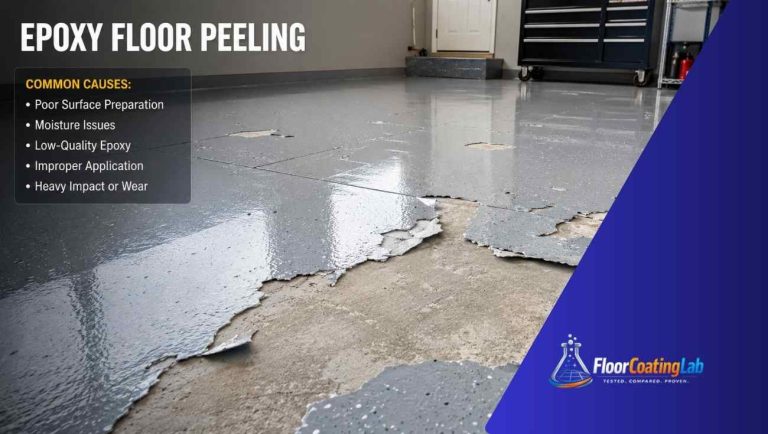
If moisture pushes up from underneath a non-breathable, rigid barrier, it generates intense pressure that can cause rigid coatings to fracture or release their bond entirely.
Summary
Understanding the baseline chemistry prevents costly failures. Drylok floor paint and 1-part epoxy esters dry via evaporation to create a flexible, breathable, user-friendly finish suited for light-duty areas.
True 2-part epoxies transform via a chemical reaction into a dense, rigid, impermeable plastic armor engineered to take a beating from heavy vehicles and chemicals.
Related Article: Best DIY Epoxy Floor Kits of 2026
The Moisture Paradox: Hydrostatic Pressure vs. Moisture Vapor Barriers
Concrete looks solid, but under a microscope, it resembles a hard sponge filled with capillary networks. If your concrete slab is cast directly over dirt—common in basements and older garages—moisture from the earth constantly migrates upward.
This creates two distinct challenges for floor coatings: hydrostatic pressure (liquid water pushing up) and moisture vapor transmission (water gas evaporating out).
Products like the specialized drylok floor and wall masonry waterproofer are engineered to combat active moisture. When applied to bare concrete, it penetrates the pores and forms a chemical block capable of resisting up to 4 to 10 PSI of hydrostatic pressure.
Standard latex concrete floor paint, along with acrylic-based systems, offers a “breathable” film. This means that while it stops top-down spills, it allows microscopic amounts of water vapor underneath to pass through harmlessly instead of building pressure.
True 2-part epoxy systems act as a total concrete moisture vapor barrier. They lock the surface down entirely. However, if your slab has a high moisture emission rate (greater than 3 pounds per 1,000 square feet over 24 hours), a standard 2-part epoxy will fail.
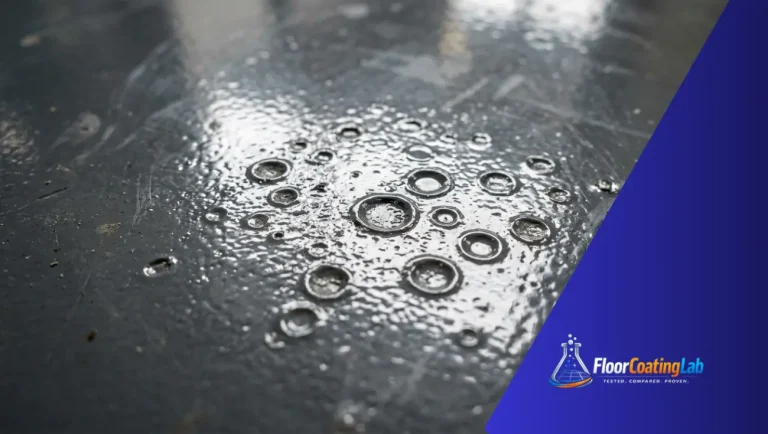
The trapped water vapor collects beneath the impermeable resin, building pressure until it forces the epoxy away from the concrete, resulting in large blisters and localized cracking.
Durability Under Load: Abrasion, Chemical Spillages, and Hot Tire Pickup
If moisture controls the underside of your coating, traffic controls the surface. The way a floor coating responds to abrasive force and weight dictates its long-term viability in demanding areas.
| Performance Metric | Drylok Concrete Floor Paint | Drylok E1 1-Part Epoxy | True 2-Part Epoxy Resin |
| Primary Base | Acrylic / Latex | Epoxy Ester Resin | Cross-linked Polymer Resin |
| Film Profile | Thin, flexible skin | Medium, fortified film | Thick, rigid armor |
| Foot Traffic | Light to Moderate | Heavy Foot Traffic | High Industrial Impact |
| Vehicular Travel | Not Recommended | Rated for Vehicles | Recommended / Heavy Duty |
| Chemical Shield | Low (Stained by oil) | Moderate (Resists grease) | High (Resists solvents/acids) |
A primary reason traditional paint fails on garage floors is hot tire pickup resistance. When you drive your vehicle, the tires heat up from road friction and expand.
When you park on a standard latex floor, the hot rubber cools down, contracts, and physically grabs onto the flexible paint film. As you drive away, the tire pulls the paint right off the concrete substrate.
While a basic drylok concrete floor paint vs epoxy comparison favors resin, the drylok e1 1-part epoxy review notes that its advanced epoxy ester formulation is specifically fortified to resist hot tire pickup.
However, under heavy vehicular usage, even fortified 1-part epoxies can suffer from plasticizer migration—a chemical reaction where compounds in the tire rubber slowly degrade the paint polymers over time.
Only a true, 100% solids 2-part epoxy offers complete garage floor coating durability against heavy vehicles, jack stands, dragged toolboxes, and aggressive chemical spills like brake fluid or battery acid.
Application Mechanics: The DIY Window vs. The Race Against Pot Life
The application phase highlights the practical trade-off between absolute durability and ease of use.
The Open-and-Pour Convenience
Water-based acrylics and 1-part epoxy ester coatings are remarkably forgiving. You pop the lid, stir the contents, and start rolling.
If you need to stop for lunch or finish the project the next morning, you simply wash your roller with soap and water, hammer the lid back on, and resume when ready. The material remains stable in the liquid phase because it requires air exposure to initiate evaporation and drying.
The Strict Pot-Life Deadline
Working with a true 2-part epoxy requires precision planning. The moment Part A and Part B are combined, the chemical countdown begins. This window is called pot life-the exact amount of time you have to apply the mixed resin before it turns into an unusable, boiling block of plastic inside the bucket.
Depending on the ambient temperature, your pot life can range from 20 to 45 minutes. You cannot stop midway through, and any material left in the bucket past its pot life is permanently ruined. Additionally, 2-part epoxies can emit volatile organic compounds (VOCs) and harsh amine odors during the curing phase, requiring active ventilation.
The Lifetime Cost Calculator: Upfront DIY Savings vs. Long-Term Maintenance Cycles
When budgeting for a project on floorcoatinglab.com, look beyond the initial purchase price to consider the cost per square foot over time.
- Drylok Floor Paint and 1-Part Systems: These offer low upfront costs. A single gallon typically covers 300 to 400 square feet per coat and requires minimal tools. However, in heavy traffic zones, these evaporative films wear down quickly. They generally require a fresh maintenance coat every 2 to 4 years to combat traffic paths and fading.
- True 2-Part Epoxy Kits: The initial investment is significantly higher. High-build kits require specialized tools like spiked shoes, notched squeegees, and mechanical mixers. However, because the resulting surface is an industrial-grade plastic shell, a properly applied 2-part epoxy can easily last 10 to 15 years under harsh residential conditions without peeling, chipping, or requiring a recoat.
Summary
The head-to-head performance reveals a clear division: Drylok and 1-part epoxy products excel in ease of application, fast cleanup, and breathability for slabs prone to mild water vapor transmission.
True 2-part epoxies demand precise execution within a strict pot-life window, but provide superior long-term durability, chemical protection, and resistance to vehicular wear.
Related Article: Polyaspartic vs Epoxy – The Deep Science of Concrete Floors
Concrete Prep Protocols: Why Both Systems Fail Without Deep Substrate Work
Whether you choose a basic floor paint or an elite industrial resin, your coating is only as good as the preparation underneath it. The single biggest mistake DIYers make is treating concrete like drywall-assuming cleaning the surface is enough. Concrete must be structurally sound, free of sealers, and mechanically open to receive a new layer.
The Moisture and Porosity Diagnostics
Before picking up a roller, you must perform two tests:
The Plastic Sheet Test: Tape a 12×12-inch piece of clear plastic sheeting securely to your bare concrete floor using moisture-resistant tape. Leave it for 24 hours. If condensation appears on the underside of the plastic, or if the concrete beneath looks darker, your floor has a high rate of water vapor transmission. Rigid, non-breathable 2-part epoxies will likely bubble here unless a dedicated moisture barrier primer is used first.
The Water Bead Test: Drop spoonfuls of water onto various sections of the slab. If the water instantly soaks in and darkens the concrete, the pores are open. If the water beads up like a freshly waxed car, an old sealer or tight machine-troweled finish is blocking penetration. The floor must be etched or ground down.
Achieving the Sandpaper Profile
To create a permanent bond, the concrete surface profile (CSP) must be roughened. This is typically achieved via two main methods:
- Acid Etching Concrete Floor DIY: For homeowners handling light-duty products like Drylok, acid etching using a sulfamic or muriatic acid solution profile dissolves the smooth surface paste. This opens the micro-capillaries, leaving behind a texture that feels exactly like medium-grit sandpaper.
- Mechanical Diamond Grinding: Essential for true 2-part epoxies. Using an industrial rotary grinder equipped with diamond-segmented blocks profile physically shears off the top layer of smooth concrete paste. This process exposes the hard stone aggregate beneath, providing deep crevices for heavy resins to grip into.
The Critical Sin: Can You Epoxy Over Drylok?
A highly frequent question among homeowners looking to upgrade their basement floor is: “Can I apply a durable 2-part epoxy topcoat directly over my existing Drylok floor paint to make it last longer?”
The answer is an absolute, non-negotiable NO.
Understanding the structural science clarifies why this combination fails. A true 2-part epoxy cures into an incredibly heavy, hard, and chemically rigid plastic layer. When it shrinks slightly during the exothermic cross-linking phase, it exerts immense physical tension on the layer underneath it.
Products like standard latex concrete floor paint remain soft, flexible, and chemically rubbery by comparison. If you apply a rigid, heavy epoxy over a soft, flexible acrylic base coat, the intense tension of the curing epoxy will tear the flexible paint layer right off the concrete substrate.
Within weeks, the entire system will delaminate in large sheets, ruining both products and requiring aggressive mechanical grinding to fix. You can paint over epoxy once it is thoroughly abraded, but you can never epoxy over a flexible paint.
The Buying Blueprint: Which One Should You Choose?
Choose Drylok Concrete Floor Paint / E1 1-Part Epoxy If:
- You are renovating a basement recreation room or utility closet that experiences foot traffic but zero vehicular loads.
- The slab fails the plastic sheet test, showing mild, persistent water vapor transmission that requires a breathable coating.
- You need a straightforward DIY weekend project with easy soap-and-water cleanup and zero pot-life anxiety.
- You are working on a strict budget and want a clean, aesthetic finish without investing thousands in industrial equipment.
Choose a True 2-Part Epoxy System If:
- You are coating a garage floor that handles passenger vehicles, trucks, or heavy automotive repair machinery.
- You require absolute protection against harsh chemicals, motor oil drips, gasoline, and hot tire pickup.
- The slab is completely dry underneath, passing the moisture tests with zero hydrostatic pressure concerns.
- You want a smooth showroom shine or decorative color flake appearance that won’t require recoating for a decade or more.
Summary
Surface preparation is paramount: both coatings will peel instantly if applied over oily, unetched, or sealed concrete. Chemical compatibility rules dictate that hard 2-part epoxies cannot be layered over soft acrylic floor paints. Match your product to your floor’s environment—breathable paints work well for damp, light-duty utility zones, while chemical cross-linked resins are required for heavy-duty garage spaces.
Frequently Asked Questions (FAQs)
Can you apply true 2-part epoxy over Drylok floor paint?
No. Hard, rigid 2-part epoxies exert high mechanical tension while curing. If applied over a softer, flexible latex or acrylic base like Drylok, the epoxy will crack, blister, and pull the underlying paint completely off the floor.
Does Drylok E1 resist hot tire pickup?
Yes, Drylok E1 uses an advanced epoxy ester resin formulation that is specifically designed to resist hot tire pickup in residential garage environments. However, it may still be susceptible to long-term staining or chemical degradation from high-performance racing tires or prolonged exposure to standing automotive fluids.
How long does Drylok floor paint last compared to professional epoxy?
Drylok floor paint and fortified 1-part epoxies generally last between 2 to 4 years in active residential settings before traffic paths begin to show wear and require a maintenance coat. In contrast, a professionally prepped, 100% solids 2-part epoxy system can easily last 10 to 15+ years under harsh garage conditions.
Do I need to prime my floor before using concrete paint?
For products like Drylok E1, a standalone primer is typically not required, provided the bare concrete has been thoroughly cleaned, degreased, and acid-etched to open up its pores. The first coat acts as its own self-priming anchor layer into the masonry.
Can either product stop active water leaks coming through the floor?
While drylok floor and wall masonry waterproofer can block low-pressure dampness on bare masonry walls, no topical floor coating can permanently stop severe hydrostatic pressure or active water leaks pushing upward through a horizontal floor slab. Active water pressure will eventually blister and delaminate both floor paint and epoxy resins.
Conclusion
Choosing between drylok concrete floor paint vs epoxy ultimately comes down to matching the product’s internal chemistry to the physical reality of your slab. If you are looking to brighten up a damp utility basement on a budget, the breathability and open-and-pour simplicity of an acrylic or 1-part epoxy ester system makes it a highly effective choice.
If you are looking to transform a working garage into a chemical-resistant, industrial-grade workspace that laughs at hot tires and heavy jacks, taking the time to mechanically grind the slab and mix a true, two-part cross-linked epoxy resin is well worth the extra investment. Assess your floor’s moisture levels, define your traffic needs, and prep your concrete thoroughly to enjoy a seamless, beautiful finish that lasts.
To see a practical comparison of these coatings under real-world garage and workshop conditions, watch this Concrete Floor Paint Breakdown Video which reviews top-performing floor coatings and details how basic paints stack up against professional systems.

2 Comments
Comments are closed.