
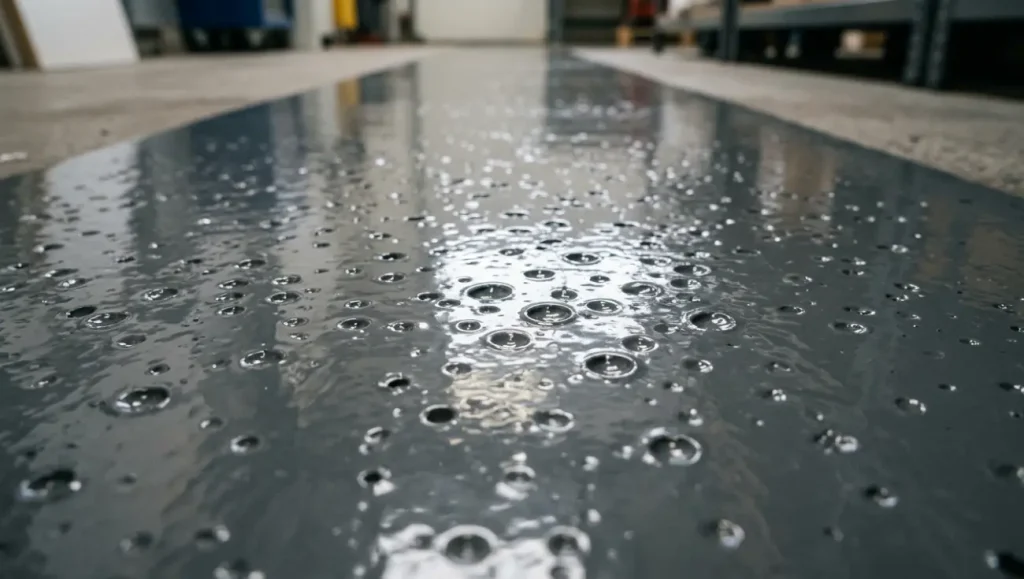
You’ve poured your beautiful, high-solids epoxy floor, and everything looks perfect-until you notice tiny, circular craters forming right in front of your eyes. These are fish eyes in epoxy, and they can turn a professional-looking project into a frustrating mess.
If you’re asking what are fish eyes in epoxy, they are essentially surface tension failures where the wet coating pulls away from a contaminant on the slab. Whether you are dealing with a garage floor or a tabletop, seeing them appear means the resin cannot wet out the surface properly.
The short answer: Fish eyes in epoxy are caused by contaminants-usually oil, silicone, or even microscopic dust—that create low surface tension areas, causing the resin to repel. To fix fish eyes in epoxy floor coatings, you must stop the application immediately, allow the area to cure, sand the defect flat, and thoroughly clean the spot before re-applying a fresh topcoat.

What Causes Fish Eyes in Epoxy?
Understanding the “why” is the only way to prevent this from ruining your project. Epoxy is a chemical system that demands a pristine, high-energy surface to bond.
- Silicone Contamination: This is the #1 culprit. Even a tiny amount of hairspray, furniture polish, or lubricant in the room can settle on the concrete and cause immediate repelling.
- Surface Oil and Grease: If you didn’t perfectly degrease the slab, residual oil acts as a barrier that the epoxy physically cannot cover.
- Moisture or Humidity: Excessive moisture in the air or on the concrete surface can interfere with the resin’s ability to “lay down” flat.
- Dust and Particulates: Sometimes, it’s not chemical—it’s physical. Fine debris can create a point of friction that forces the liquid epoxy to flow around it.
How to Prevent Fish Eyes in Epoxy (Before They Start)
The best fix is prevention. Because once they appear, they are difficult to “chase” without causing more damage.
- Strict Clean-Room Protocols: Keep all aerosols, silicone sprays, and cleaning chemicals far away from your workspace.
- Solvent Wiping: Always perform a final wipe with an appropriate solvent (like denatured alcohol or acetone, depending on your product) just before mixing.
- Check Your Air Source: If you are using a compressor to blow off dust, ensure it has an oil/water separator installed. If your compressor is leaking oil into the air stream, you are essentially spraying the contamination directly onto the floor.
- Check Concrete Porosity: Use a water drop test. If water beads up anywhere, you have a contamination spot that will absolutely trigger a fish eye.
Related Article: Can You Use Epoxy Floor Paint on Wood?
How to Get Rid of Fish Eyes in Epoxy: A Step-by-Step Fix
If you have already started and they are appearing, do not try to “brush over” them while the epoxy is still wet. This almost always makes it worse.
Stop and Let Cure:
Allow the epoxy to reach a full cure. If you try to work with it while it’s tacky, you will just drag more contamination into the wet resin.
Sand the Defects:
Once hard, use 80-to-120 grit sandpaper on a sanding block to level the crater. You need to remove the “lip” of the fish eye so the surface is perfectly flat.
Deep Clean:
After sanding, vacuum the area thoroughly with a HEPA-filter vacuum. Wipe the sanded area with the manufacturer-recommended solvent to remove every trace of dust and residue.
Re-Apply the Topcoat:
Mix a fresh batch of epoxy and apply it over the sanded repair. Because the surface is now clean and properly prepared, the new resin will wet out and fill the crater.
| Scenario | Recommended Action |
| Just started pouring | Stop immediately; find the source of contamination. |
| Epoxy is wet/tacky | Step away; do not touch. Let it cure first. |
| Epoxy is fully cured | Sand flush, degrease the area, and re-coat. |
Frequently Asked Questions
What are fish eyes in epoxy?
Fish eyes are circular craters or “divots” that form in wet epoxy, exposing the substrate underneath. They occur because the epoxy coating has a higher surface tension than the contaminated surface, causing it to retract and “bead up” around the defect.
How to fix fish eyes in epoxy floor coatings?
You cannot fix them while the epoxy is still wet. You must wait for the floor to fully cure, sand down the cratered area until it is smooth and level with the surrounding floor, clean the spot with a solvent to remove all oils and dust, and then apply a fresh topcoat of epoxy.
What causes fish eyes in epoxy during application?
The primary causes are contaminants like silicone, oil, grease, or even microscopic dust particles on the floor. When the liquid epoxy hits these spots, it repels rather than spreading, creating the characteristic cratered appearance.
How do I prevent fish eyes in epoxy?
Prevention requires a perfectly clean surface achieved through rigorous mechanical grinding, followed by a final solvent wipe. Additionally, ensure no silicone products are present in the environment, and if you use compressed air to clean your surface, ensure your air lines are free of oil and moisture.


4 Comments
Comments are closed.